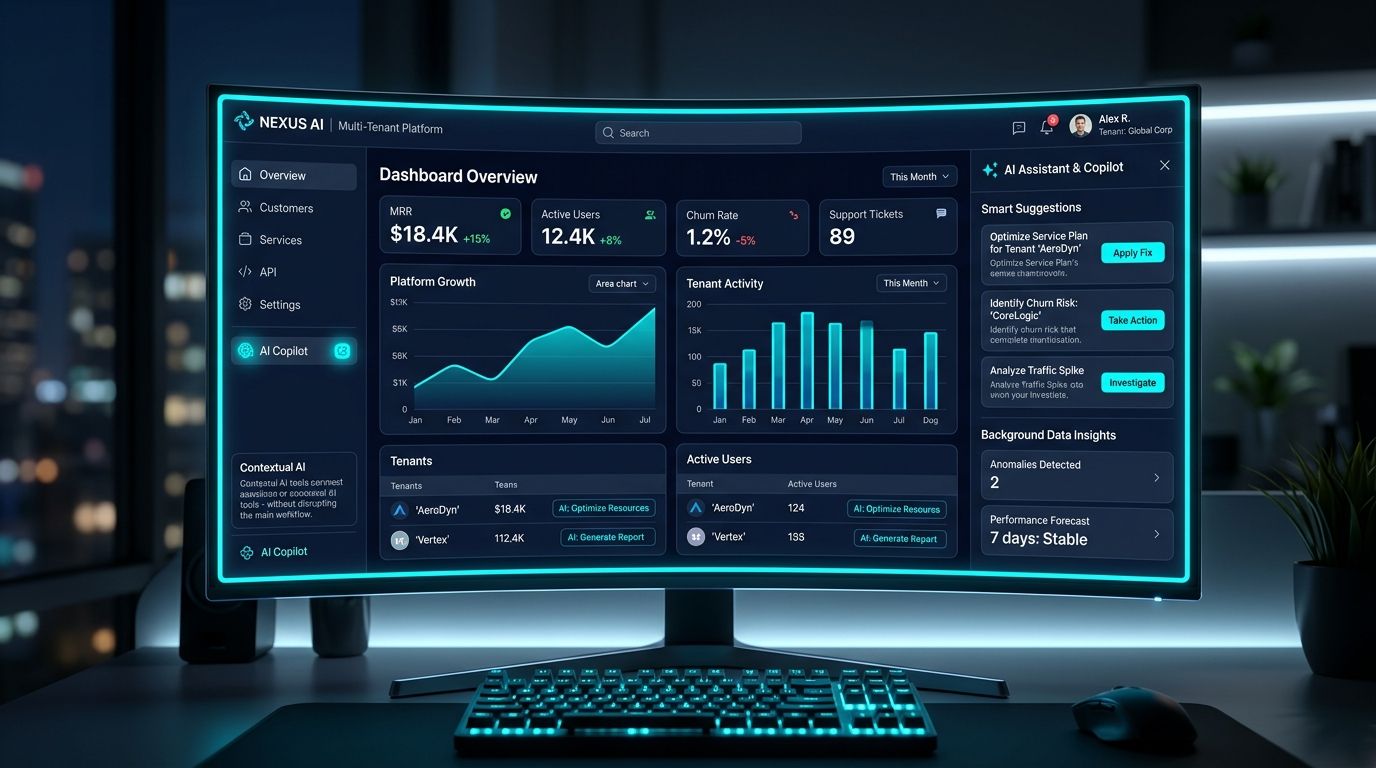
Every software company in the world is currently facing intense pressure from board members, investors, and customers to "add artificial intelligence." In response, engineering teams across the SaaS industry are rushing to bolt generic chatbots onto existing dashboards, sprinkle glittering "✨ Ask AI" buttons across database tables, and wire raw model provider APIs directly into production controllers. The result is almost universally disappointing: jarring user experiences that solve no identifiable operational problem, unpredictable multi-second latencies, spiraling monthly API bills, terrifying tenant data exfiltration vulnerabilities, and fragile applications that crash whenever an external model provider suffers a transient outage. AI does not need to be the product itself to deliver transformative enterprise value. In a world-class SaaS platform, artificial intelligence is an architectural capability—subordinated to deterministic business rules, governed by strict multi-tenant boundaries, and deployed only where probabilistic reasoning out-performs traditional code. The foundational architectural axiom of modern cloud engineering is simple: The database knows what happened. The business logic knows what is allowed. The AI helps interpret what it means.
1. The "✨ Ask AI" Anti-Pattern: How Teams Ruin Great SaaS Products
To understand how to integrate artificial intelligence correctly, we must first diagnose why the overwhelming majority of early SaaS AI features fail in production. Consider the typical journey of an established enterprise software product—whether it is a specialized ERP, an HR management suite, a logistics dispatcher, or a B2B billing engine.
Prior to the current generative AI wave, this SaaS product worked predictably. It possessed a robust PostgreSQL or MySQL relational schema, a deterministic authorization engine enforcing tenant boundaries and Role-Based Access Control (RBAC), battle-tested background workers processing asynchronous queues, and clean, high-density data tables where enterprise users could view, sort, and reconcile their daily operations with sub-100-millisecond response times.
Then came the executive directive: "We need an AI story before our next customer summit or funding round."
Lacking a disciplined architectural framework, the product team inevitably ships the classic "✨ Ask AI" anti-pattern:
- The Unbounded Floating Chatbot: A generic chat bubble anchored in the bottom-right corner of the interface. When an operations manager opens it, the prompt placeholder reads: "Ask me anything about your business..." The user has no idea what data the model has access to, what questions it can reliably answer, or what actions it can trigger. When they ask a precise financial question, the model hallucinates an aggregate number because it was never given deterministic SQL access.
- The Cosmetic Magic Wand: An arbitrary AI icon dropped next to standard text inputs that takes 3,000 milliseconds to rephrase a perfectly functional sentence into generic marketing fluff, adding friction rather than eliminating it.
- Direct Controller Coupling: Product developers importing third-party SDKs (such as OpenAI or Anthropic) directly into HTTP route handlers, bypassing tenant scoping, omitting rate limits, leaking raw customer PII into external model prompts, and causing entire API endpoints to hang whenever the upstream provider's latency spikes.
When users encounter these bolted-on gimmicks, engagement drops to zero within weeks. Enterprise customers do not pay SaaS subscriptions to engage in casual open-ended conversations with a chatbot. They pay for software that executes business workflows reliably, maintains an auditable system of record, guarantees data privacy, and saves their staff measurable hours of manual operational effort.
As established in our analysis of AI Agents vs Traditional Automation, probabilistic models excel at handling unstructured ambiguity, messy semantics, and dynamic interpretation. They are fundamentally unsuited for deterministic accounting, exact counting, relational constraints, or unverified transactional mutations. If you treat AI as a wholesale replacement for your SaaS architecture, your product will fail. But when you treat AI as an acceleration layer embedded within a rigorous deterministic harness, it unlocks capabilities that were mathematically impossible a decade ago.
The 10-Question SaaS AI Feature Test
Run every proposed AI feature through these ten architectural filters before writing a single line of production code
2. The Five Legitimate Roles of AI in a SaaS Application
When an engineering team strips away the marketing hype, generative models and natural language transformers possess five core technical competencies within enterprise software. A successful AI feature does not attempt to be an all-knowing oracle; it anchors itself specifically to one of these five roles:
Role 1: Understand (Unstructured Ingestion & Extraction)
Enterprise software is frequently choked by messy, unstructured inbound data: PDF commercial invoices, scanned bills of lading, customer support tickets written in colloquial Arabic or English, RFP documents, and multi-threaded email chains.
Traditionally, extracting structured attributes from these documents required complex, brittle regular expressions or human data-entry teams. Today, this is where LLMs shine: reading unstructured text and compiling it into strongly typed, schema-validated JSON structures (e.g. using Pydantic or Zod) that can be ingested directly into standard relational tables. The AI does not manage the database; it simply acts as an intelligent translator converting human chaos into clean database rows.
Role 2: Find (Semantic Retrieval & Hybrid Search)
The biggest product discovery failure in SaaS AI is assuming users want to talk to their software. In reality, search comes before chat. In more than 80% of enterprise use cases where a user interacts with a conversational interface, what they actually want is fast, accurate information retrieval across their company's tickets, technical documentation, past proposals, or customer communication logs.
Rather than forcing users into a slow, multi-turn chat dialog, high-performance SaaS platforms embed AI directly into their search bar. By combining vector embeddings with PostgreSQL tsvector lexical search (hybrid search) strictly partitioned by tenant_id, users can type natural questions like "Contracts signed in Q2 with payment terms over 60 days" and instantly receive structured results without waiting for an LLM to generate paragraphs of text.
Role 3: Explain (Summarization & Narrative Synthesis)
Enterprise databases contain vast amounts of precise data that users struggle to synthesize: 50 historical change-log events on a server cluster, 30 customer support interactions across three channels, or 100 line items on a quarterly vendor audit.
AI excels at narrative synthesis. Given a pre-filtered, authoritatively queried dataset, the model can generate a three-bullet executive briefing: "Customer satisfaction dipped in August due to recurring latency on the European gateway, resolved on August 18 following database index migration." Here, the deterministic database provides the exact historical facts; the AI provides the explanatory prose.
Role 4: Create (Context-Aware Drafting & Synthesis)
Drafting content from a blank slate is an enormous operational bottleneck for enterprise workers—whether writing customer renewal emails, drafting technical incident postmortems, or authoring compliance policy templates.
In this role, the SaaS platform automatically queries the relevant relational context (the customer's subscription tier, past support tickets, open feature requests), populates a structured prompt, and places a context-rich draft directly inside an editable rich-text field. The AI never sends the email or publishes the document; it simply gives the human a 90% completed starting point that they can refine in seconds.
Role 5: Assist with Action (Workflow Preparation & Parameterized Proposals)
The highest tier of AI utility in SaaS is assisting users with complex software actions: moving a pipeline stage, configuring a cloud firewall rule, or scheduling a preventative maintenance dispatch.
Crucially, the AI does not execute the action directly against the database. Instead, the model acts as a compiler: it interprets the user's intent, validates the request against the schema, and constructs a parameterized mutation payload. The application UI then renders a preview card showing the exact changes: "The following 4 invoices will be marked as paid via wire transfer with reference #8841. Confirm?" The human remains the authoritative gatekeeper.
3. Separation of Concerns: The SaaS + AI Core Architecture
The single most dangerous architectural mistake in SaaS AI engineering is blurring the boundary between your authoritative transactional state and external probabilistic model providers. If your database queries, billing operations, and authorization logic are directly coupled to model responses, your platform inherits all of the model's unpredictability.
A resilient SaaS application enforces a strict separation of concerns through an explicit layered pipeline:
Authoritative Application Engine vs AI Capability Layer
How production SaaS systems isolate probabilistic inference from deterministic business truth
tenant_id), RBAC role evaluationCore Business Logic
- • Authoritative transactional workflows
- • Billing, subscription & quota enforcement
- • Strict relational foreign-key integrity
- • Audit logging & compliance history
- • Millisecond response SLAs (p99 < 80ms)
AI Gateway & Pipelines
- • Tenant-scoped context assembly & minimization
- • Prompt templating & version management
- • Token rate limiting & cost budgeting per tenant
- • Fallback cascades across model providers
- • Structured JSON schema enforcement
The Calculator Rule: Calculators Must Calculate
One of the most frequent sources of catastrophic software failure occurs when developers treat Large Language Models as mathematical calculators or analytical databases.
Consider this real-world scenario from a financial invoicing SaaS: a customer types into an AI assistant: "What was our total revenue from enterprise clients in Riyadh during Q3, and what is our estimated VAT liability at 15%?"
If the developer constructs a prompt that injects 400 raw invoice records into the model context and prompts the LLM to "Sum the invoice totals and calculate 15% VAT," the feature is doomed to fail. LLMs do not calculate arithmetic; they predict token sequences. The model will effortlessly invent a plausible-sounding number that is mathematically incorrect by thousands of dollars.
The architectural rule is uncompromising: Never ask an LLM to count, sum, aggregate, or apply mathematical formulas to customer data.
Instead, the deterministic backend must query the database:
SELECT
  COUNT(id) AS invoice_count,
  SUM(subtotal_cents) AS total_revenue_cents,
  SUM(tax_cents) AS total_vat_cents
FROM invoices
WHERE tenant_id = $1
  AND client_region = 'Riyadh'
  AND client_tier = 'enterprise'
  AND issue_date BETWEEN '2026-07-01' AND '2026-09-30';
The database returns exact numbers in 12 milliseconds. Those exact, verified metrics are then passed into the LLM prompt as immutable facts: { revenue: "$142,500.00", vat: "$21,375.00", count: 18 }. The LLM's only responsibility is to format the narrative explanation. The database calculates; the AI articulates.
Authoritative Application State vs Generated AI State
A rigorous boundary dividing what must be deterministic from what can be probabilistic
| System Dimension | Authoritative Application State | Generated AI State |
|---|---|---|
| Storage Medium | PostgreSQL, MySQL, Redis, DynamoDB (ACID relational data) | Ephemeral cache, vector stores (Pinecone, pgvector), transient memory |
| Mathematical Operations | SQL aggregates, balance reconciliations, billing calculations | Zero math authority. Formatting and explanatory phrasing only |
| Permissions & RBAC | Hardcoded middleware, DB constraints, row-level security | Subject to permissions; cannot grant or elevate user rights |
| Reproducibility | 100% deterministic (Identical inputs produce identical outputs) | Probabilistic (Temperature > 0 causes slight textual variance) |
| Persistence Lifecycle | Permanent audit logs, immutable financial and user records | Cacheable, regenerable, discardable without data corruption |
| Failure Consequence | Application downtime, data corruption, financial liability | Temporary feature degradation; core workflows remain fully operational |
4. The Centralized AI Gateway: Why You Never Call Model APIs Directly
In the early days of a prototype, it is tempting for a software engineer to install the official SDK of OpenAI or Anthropic directly inside a feature controller. By the time a SaaS platform supports five different AI features across multiple engineering teams, this uncontrolled direct coupling becomes an operational nightmare:
- API keys and credentials scattered across dozens of microservices.
- Zero visibility into token expenditures per tenant, leading to unbilled API cost overruns as highlighted in Why SaaS Products Become Expensive to Scale.
- Inconsistent error handling, prompt versioning, and latency timeouts.
- Total vendor lock-in to a single model provider's proprietary API format.
Production-grade SaaS architectures decouple product features from external model providers using a Centralized AI Gateway / Service Boundary:
The Centralized SaaS AI Gateway
A unified service boundary providing rate-limiting, tenant attribution, caching, and model cascades
Enforces rate limits, monthly token quotas, and financial margin attribution per tenant_id.
Redis-backed prompt caching serving repetitive queries in 5ms without external model API charges.
Automatically reroutes requests from primary models to secondary providers upon timeout or 5xx errors.
Version-controlled prompt templates with automated regression evals and security linting.
Strips credit card numbers, national IDs, and sensitive customer secrets before model transmission.
Logs prompt tokens, completion tokens, latency, schema validation success, and model versioning.
When an engineering team routes all AI operations through a centralized gateway, product developers interact with clean internal interfaces: aiGateway.generateStructuredDraft({ tenantId, featureKey, context }). If a model provider changes its pricing, deprecates an endpoint, or suffers an outage, the platform engineering team can swap models or enable fallbacks centrally without touching a single line of frontend or product code.
5. Security, Tenant Isolation, and RBAC in the Context Pipeline
The introduction of AI into a SaaS application fundamentally alters your application security model. In a traditional SaaS architecture, SQL queries and REST APIs are strictly bounded by parameterized queries and middleware session checks. But when an LLM is introduced, the model's context window becomes an active security boundary.
If your context assembly pipeline is sloppy, you risk two catastrophic enterprise vulnerabilities:
- Cross-Tenant Data Exfiltration: An operations user at Tenant A inputs a prompt designed to probe the model's memory or vector database, inadvertently causing the system to retrieve documents or embeddings belonging to Tenant B. As detailed in our comprehensive guide on Multi-Tenant Data Isolation, tenant boundaries must be physically or logically unbreachable.
- Internal RBAC Privilege Escalation: A junior customer support agent with "Tier 1 Support" permissions uses the AI assistant to summarize "Recent executive salary discussions" or "Upcoming corporate acquisition targets." If the AI pipeline retrieves all company documents without filtering by user role, the AI acts as an unauthorized privilege escalation backdoor.
The Secure Context Assembly & Execution Flow
Seven defensive stages required before any customer data is exposed to probabilistic model inference
tenant_id and user_id from cryptographically signed server cookies.WHERE tenant_id = $1 AND role_clearance <= $2 clauses.<user_input>) with explicit system instructions prohibiting system prompt overrides.Time-of-Check vs Time-of-Action (TOCTOU)
A subtle but critical security vulnerability in SaaS AI workflows is the Time-of-Check to Time-of-Action (TOCTOU) gap.
Imagine a scenario where an AI assistant examines a customer record at 10:00:00 AM and confirms that a client has an outstanding balance of $2,000. The AI recommends: "Send reminder email and apply late fee penalty."
At 10:00:15 AM, the client's accounting department pays the $2,000 invoice via Stripe webhook.
At 10:00:30 AM, the operations manager clicks the AI assistant's "Confirm & Execute" button. If the backend naively executes the action based on the AI's earlier reasoning, the system will apply a late fee to an invoice that has already been settled!
Production systems never assume that an AI's prior observation remains true at execution time. When the user confirms an action, the backend re-validates the database state inside an atomic transaction:
// Atomic Time-of-Action validation in backend controller
export async function executeAiProposedPenalty(tenantId: string, invoiceId: string, proposedFee: number) {
  return await db.transaction(async (tx) => {
    // 1. Re-query authoritative current state with row locking
    const invoice = await tx.invoice.findUnique({
      where: { id: invoiceId, tenantId },
      include: { payments: true }
    });

    if (!invoice || invoice.status === 'PAID') {
      throw new ConflictError("Invoice status has changed since AI recommendation was generated.");
    }

    // 2. Execute deterministic business mutation
    return await tx.invoice.update({
      where: { id: invoiceId },
      data: { penaltyFee: proposedFee }
    });
  });
}
6. Resilience & Graceful Degradation: Surviving Model Outages
In the world of cloud infrastructure, external AI model APIs are among the least reliable dependencies you will ever integrate into your stack. Major foundation model providers frequently experience elevated latencies, HTTP 503 service unavailabilities, token rate limit rejections, and sporadic network timeouts.
If your SaaS application is designed such that a model outage renders your core product inoperable, your architecture is broken. A customer who cannot view their invoices, dispatch their logistics trucks, or update customer records because an external AI API is down will cancel their subscription.
The engineering standard for SaaS AI is Graceful Degradation:
Operational State: Normal vs AI Outage Degradation
How an enterprise SaaS platform maintains 100% operational uptime during upstream AI provider failures
Normal Operations (All Systems Online)
NORMAL OPERATION- • Search Experience: Hybrid search combining PostgreSQL full-text indexing with vector semantic embeddings.
- • Support Triage: Inbound tickets automatically classified and tagged by background AI workers within 3 seconds.
- • Customer Replies: "Draft Response with Context" button instantly populates rich-text editor with customized proposal.
- • Data Pipeline: Unstructured invoice PDFs parsed into structured line-item tables via vision models.
- • Reporting: Executive KPI dashboards display automated natural language summaries alongside charts.
Degraded Mode (AI Provider Outage / 503s)
AI OUTAGE / DEGRADED- • Search Experience: Seamlessly falls back to pure PostgreSQL
tsvectorkeyword matching. Zero search interruption. - • Support Triage: Tickets routed via deterministic keyword regex rules; unclassified items placed in standard review queue.
- • Customer Replies: Draft button displays non-intrusive toast: "AI drafting temporarily paused." Manual editor fully functional.
- • Data Pipeline: PDFs queued in Redis/SQS with exponential backoff retries. Zero dropped files; manual entry available.
- • Reporting: Dashboards display 100% of charts and numerical metrics; narrative summary cleanly hidden.
To achieve graceful degradation, every AI feature call must be wrapped in strict timeout boundaries (typically 3,000ms for user-facing UI interactions and 15,000ms for background batch jobs) with automated circuit breakers. When the circuit breaker opens, the application immediately switches to degraded mode without waiting for timeouts on subsequent user clicks.
7. Real-World Architectural Walkthrough: An Enterprise SaaS CRM
To see these architectural principles operating together in a real-world production system, let us examine an enterprise B2B CRM application. Instead of plastering a giant "AI Assistant" button across the navbar, the engineering team introduces five tightly focused, bounded AI features designed to accelerate specific sales operations:
The Bounded SaaS CRM AI Implementation
Five discrete AI capabilities integrated into an enterprise sales platform with zero architectural pollution
Inbound Lead Triage
Parses inbound emails into typed JSON. Validates budget ranges deterministically and assigns lead ownership via round-robin database rules.
NLP Pipeline Filter
Translates human query into typed SQL filters. The database executes the query. The LLM never touches customer financial balances directly.
Account Context Drafting
Pre-fetches recent CRM notes into prompt. Populates editable textarea. The sales rep inspects, personalizes, and clicks the standard "Send" button.
Pipeline Health Briefing
Calculates pipeline velocity and win-rates in PostgreSQL. Prompts LLM to articulate major risks and highlight deals with declining activity.
Bounded Stage Migration
AI prepares stage change payload from email attachment. UI renders modal with highlighted diff. Sales manager confirms before database write.
Circuit Breaker Fallback
If model API fails, lead parsing falls back to keyword regex, NLP filter defaults to standard dropdowns, and drafting buttons show polite status.
Notice what makes this implementation successful:
- At no point is the sales rep forced into an open-ended chatbot conversation.
- Every AI capability is deeply contextualized within the specific screen where the user is already doing their work.
- All financial sums and stage transitions are governed by deterministic SQL constraints.
- If all external AI APIs disappear tomorrow, the CRM continues functioning as a world-class sales management platform without missing a beat.
8. The Fictional Learning Platform Example: Kamashka Academy Pilot
To demonstrate how these concepts apply to educational and multi-tenant training platforms, consider our architectural pilot project for the Kamashka Academy multi-tenant portal.
In an educational SaaS platform, organizations (schools, corporate training departments, software academies) manage students, courses, assignments, and certifications across strict tenant boundaries.
Here is how AI capabilities are integrated without compromising core academic integrity:
- Deterministic Foundation: Student enrollment, course progression tracking, exam submissions, and certificate cryptographic hashes are stored in authoritative PostgreSQL tables governed by strict row-level security. A student cannot view assignments from another tenant academy.
- AI Learning Assistant (Level 1 - Read Only): When a student is stuck on a Python syntax exercise, they can click "Explain this Error." The backend fetches only the student's code submission and the instructor's rubric, prompting the LLM to provide conceptual guidance without giving away the direct answer. The model has read-only access and cannot modify grades or mark assignments as complete.
- Instructor Grading Co-Pilot (Level 2 - Draft Generator): When an instructor reviews 80 essay submissions, the AI reads each essay against the instructor's rubric and drafts proposed feedback comments and preliminary score suggestions. The suggestions appear in an editable draft panel. The human instructor reviews every score, makes manual adjustments, and clicks "Approve Grade." The database commit is triggered exclusively by the instructor's authenticated session.
- Deterministic Certification: When a student completes all requirements, the certificate generation engine is 100% deterministic code. The system does not prompt an AI to "generate a graduation certificate"; it executes a signed cryptographic PDF generation pipeline that ensures zero hallucinated degrees or invalid student credentials.
9. The SaaS AI Maturity Model: Autonomy Is Optional, Value Is Not
As engineering organizations mature their AI capabilities, they frequently assume that the ultimate goal is full, unsupervised autonomy (Level 5 on the Authority Ladder). In enterprise software engineering, this is a dangerous misconception.
In high-stakes enterprise domains—financial accounting, healthcare records, human resources, and supply chain logistics—unsupervised autonomy is rarely desirable. Enterprise buyers value predictability, auditability, and regulatory compliance far above unsupervised agentic freedom.
The SaaS AI Engineering Maturity Model
A structured evolutionary path from traditional deterministic software to self-optimizing SaaS platforms
Pure Deterministic SaaS
Standard relational databases, strict CRUD operations, deterministic business logic, manual user data entry. Zero artificial intelligence.
Point-Solution AI Features
Isolated AI experiments: an NLP summarizer on tickets or basic semantic search. Direct model API calls with rudimentary prompt management.
Centralized AI Gateway
Unified AI service boundary enforcing tenant rate limits, prompt caching, structured schema validation, and multi-model fallback cascades.
Context-Aware Workflow Assist
AI features deeply embedded within existing UI screens. Draft generation, parameterized action preparation, and robust human confirmation gates.
Proactive Recommendation Engine
Background telemetry analysis identifying operational bottlenecks, predicting churn risks, and surfacing actionable insights with explanatory rationale.
Bounded Self-Optimization
Autonomous execution restricted strictly to low-risk, reversible operational workflows with continuous automated auditing and rollback mechanisms.
As you progress through these maturity stages, reference our detailed guide on transitioning From MVP to Production: What Actually Changes in a SaaS Application? to ensure your monitoring, observability, and infrastructure scaling patterns keep pace with your AI feature deployments.
10. Summary Checklist: The Golden Rules of SaaS AI Architecture
To ensure your engineering team builds reliable, high-value AI capabilities that elevate your SaaS platform rather than jeopardizing its stability, adhere strictly to these core engineering rules:
- Solve User Friction, Not Investor Hype: If you cannot describe the exact operational bottleneck an AI feature removes in two sentences, do not build it. Reject unbounded "Ask AI" chat bubbles in favor of embedded, contextual capabilities.
- Keep Deterministic Truth Deterministic: The database knows what happened. The business logic knows what is allowed. The AI helps interpret what it means. Never let an LLM execute arithmetic, count records, or calculate financial totals.
- Enforce Strict Service Boundaries: Never call model provider SDKs directly from product controllers. Funnel all AI traffic through a Centralized AI Gateway that enforces tenant token budgeting, caching, and fallback cascades.
- Treat Context as a Security Boundary: Always filter vector searches and relational context by verified
tenant_idand user RBAC permissions before data enters the model prompt. Never allow an AI feature to bypass your application's authorization layer. - Require Human Confirmation for State Mutations: Keep AI at Level 1 through Level 4 on the Authority Ladder. Let the model prepare parameterized draft mutations, but require an authenticated human user to click "Confirm & Execute."
- Re-Verify at Time-of-Action: Protect against TOCTOU vulnerabilities by atomically re-checking entity state and user permissions in the database before committing any AI-proposed action.
- Design for Total Provider Outages: Wrap all model calls in aggressive timeouts and circuit breakers. If an external model API goes offline for an hour, your core SaaS product must continue functioning smoothly in graceful degradation mode.
Artificial intelligence is one of the most powerful capabilities ever introduced into software engineering. When subordinate to disciplined architecture, robust multi-tenancy, and deterministic business logic, AI transforms great SaaS products into indispensable enterprise workflows.
Planning to Implement AI Agents or Modern Automation?
Bridging deterministic business workflows with autonomous AI agents requires rigorous architectural boundaries, tool encapsulation, rate limits, and human-in-the-loop oversight. Kamashka designs and builds production-grade, reliable AI and software automation systems.
The Production AI Architecture & Engineering Series
A 5-part engineering series exploring agent autonomy boundaries, pragmatic SaaS integration, deterministic safeguards, operational reliability, and architectural choices.
An architectural guide evaluating deterministic workflows vs agentic decision loops, error cost matrices, and autonomy budgets.
An architectural guide to integrating AI while preserving deterministic business rules, tenant boundaries, and RBAC security.
Why production systems enforce deterministic business rules around probabilistic models, the Three-Zone model, and the AI Sandwich pattern.
Architecting for API outages, tiered model cascades, graceful degradation, and idempotency in AI pipelines.
A pragmatic architectural guide evaluating retrieval, specialized fine-tuning, prompt engineering, and live tools.