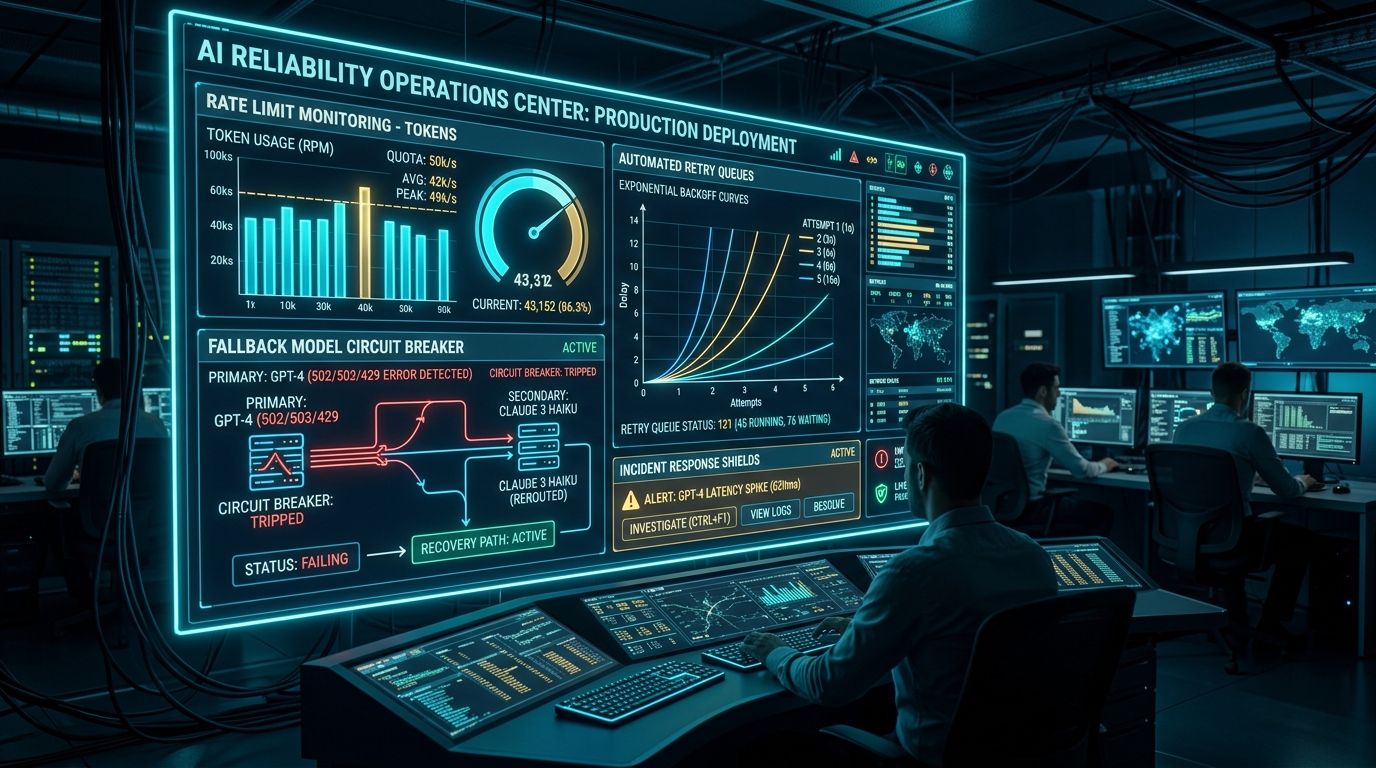
A software team connects a large language model to a feature in local development. A user clicks a button labeled Analyze System. Two seconds later, a detailed, beautifully phrased analysis renders on screen. The developers declare victory, merge the branch, and deploy to production. By morning, reality sets in: a hundred users click the button simultaneously; several double-click in impatience; one user pastes an entire 80-page log file; the primary model provider responds with HTTP 429 Too Many Requests; another batch of requests hangs indefinitely on a network timeout; a retried request creates duplicate database records; and a regional cloud outage leaves the entire customer-facing dashboard spinning. The model itself was brilliant on the happy path. The application architecture around it was completely unprepared for reality.
The Production AI Reliability Stack
Reliability is an emergent property of the entire system architecture, not a parameter of the model weights.
Debounced UI buttons, real-time streaming status, transparent error framing, and non-blocking manual workflows.
Multi-dimensional rate limiting (tenant:user:feature), burst smoothing, and monthly entitlement guardrails.
Function-level interfaces (summarizeTicket()) decoupled from vendor-specific SDKs and raw model IDs.
Jittered exponential backoff, attempt budgets, latency ceilings, concurrency limits, and circuit breakers.
Schema parsing, field sanitization, domain rule assertions, and tenant boundary verification.
Primary and secondary model routing, structured output formatting, idempotent tool calls, and RAG retrieval.
Golden signals (Traffic, Errors, Latency, Saturation, Cost, Quality), correlation IDs, and canary fallback alerts.
The Happy-Path Trap: Why Model Quality Does Not Equal Feature Reliability
Over the past three articles in our AI Engineering series, we laid the foundational blueprints for intelligent software systems. In AI Agents vs Traditional Automation (Blog #10), we analyzed how to choose between rigid deterministic code and autonomous reasoning loops based on error blast radius. In How to Add AI to a SaaS Product (Blog #11), we explored where machine intelligence should physically live inside a multi-tenant application. In Deterministic Logic + AI (Blog #12), we established the ironclad rule of production architecture: "If the system already knows the rule, the LLM should not have to guess it."
Now, we confront the inevitable operational question that separates prototype demos from mission-critical commercial platforms: What happens when the AI layer doesn't work?
In software engineering, there is a dangerous cognitive bias surrounding generative AI: teams assume that because a state-of-the-art foundation model scores 90% on benchmark evaluations, their user-facing AI feature inherits a 90% or 99% operational reliability rating. This is the happy-path trap. A foundation model is not an application; it is merely an external network dependency. It communicates over HTTP, consumes shared provider infrastructure, incurs variable monetary costs per invocation, enforces strict capacity throttles, and operates probabilistically.
Consider the complete conceptual reliability chain that must succeed for an AI feature to return a valid result to an end user:
USER REQUEST
  ↓
APPLICATION ROUTER & SESSION STATE
  ↓
AUTHENTICATION & TENANT RBAC GATES
  ↓
RATE LIMITING & TENANT QUOTA ENFORCEMENT
  ↓
CONTEXT GATHERING & VECTOR RETRIEVAL (RAG)
  ↓
AI SERVICE LAYER / CAPABILITY ADAPTER
  ↓
PROVIDER NETWORK INFRASTRUCTURE (TLS, DNS, ROUTING)
  ↓
PROVIDER INFERENCE ENGINE & GPU SCHEDULER
  ↓
FOUNDATION MODEL GENERATION
  ↓
STRUCTURAL & DOMAIN SCHEMA VALIDATION
  ↓
BUSINESS INVARIANT AUDITING
  ↓
USER INTERFACE RENDERING & STATE COMMIT
Every single arrow in this chain can fail. The network connection can drop mid-stream. The provider can return HTTP 429 or HTTP 503. The vector database can time out. The model can return valid JSON that violates a core financial constraint. The user can close their laptop lid mid-generation while an uncancelled background worker continues burning expensive GPU tokens.
To build production-grade AI features, we must internalize a foundational axiom: Design for the model to fail. Not because AI providers are uniquely fragile, but because in distributed systems, every external dependency eventually fails. Reliability is not the absence of errors; reliability is the presence of architectural safeguards that isolate, mitigate, and gracefully degrade when those errors inevitably occur.
The Comprehensive AI Failure Map
Categorizing failure modes before designing retry, fallback, and degradation strategies.
A. Request Failures
- Oversized Context: User input exceeds token window.
- Rapid Re-clicks: Impatient button spamming.
- Client Disconnect: Browser tab closed mid-generation.
- Malformed Payload: Unparsable input parameters.
B. Application & Auth Failures
- Tenant Authorization: User lacks permission for resource.
- Quota Exhaustion: Tenant monthly token allowance reached.
- Queue Saturation: Worker backlog exceeds safe depth.
- Cache Failure: Redis timeout or stale state read.
C. Provider & Network Failures
- HTTP 429 Too Many Requests: Rate limit or token spike.
- HTTP 5xx Server Errors: Upstream provider infrastructure down.
- Network Dropouts: Socket hangup or TLS handshake failure.
- Latency Spikes: Inference queues backing up upstream.
D. Model & Output Failures
- Malformed Syntax: Output breaks required JSON schema.
- Missing Fields: Mandatory keys omitted in payload.
- Safety Refusal: Unexpected false-positive content filter.
- Hallucinated Business Values: Outputs violate hard rules.
E. Tool & Retrieval Failures
- Vector DB Timeout: RAG retrieval unreachable.
- Tool Execution Failure: Internal API or database error.
- Empty Context: Zero matching documents discovered.
- Stale Tool State: Action executed against outdated data.
F. Economic & Operational Failures
- Cost Surges: Uncontrolled retry loops burning budget.
- Concurrency Exhaustion: Heavy jobs blocking all worker slots.
- Silent Model Drift: Output quality degrades post-update.
- Provider Incident Cascade: Primary outage overwhelms fallback.
Failure Classification: The Five Operational States
When an AI invocation fails, the single most dangerous architectural mistake is to treat all errors identically by wrapping the API call in a generic catch (e) { retry(); } block. Retrying an invalid user request ten times does not transform it into a valid request; it merely increases latency, consumes client battery, amplifies provider congestion, and burns cloud budget.
Before implementing retry policies or routing logic, production systems must categorize every failure into one of five operational classes:
-
Retryable Failures: Transient anomalies where an immediate or delayed retry has a high probability of success without altering the request payload. Examples include TCP reset timeouts, brief provider gateway blips (HTTP
502or503), and temporary rate limits carrying a validRetry-Afterheader. - Non-Retryable Failures: Deterministic errors where the request itself or the system configuration is invalid. Retrying identical parameters is guaranteed to produce an identical failure. Examples include invalid API credentials, bad JSON syntax in the request, queries exceeding model hard limits, authorization denials (Blog #5), and business constraint rejections.
- Degraded Failures: Situations where advanced reasoning or deep analytical synthesis is temporarily unavailable, but underlying authoritative data or partial AI processing remains intact. Rather than failing the entire screen, the system delivers a scoped, functional subset of the feature.
- User-Correctable Failures: Failures resulting from input boundaries that the user can resolve immediately. Examples include pasting a file that exceeds the character ceiling, uploading an unsupported document format, or selecting an invalid combination of filter parameters. These require clear, instructive UI guidance rather than background system retries.
- Internal / Fatal Failures: System-level software bugs, unhandled null references, corrupted environment configurations, or database connection pool exhaustions. These must be caught, safely contained, logged to observability systems with correlation IDs, and presented to the user with honest, non-cryptic status messages.
Retry Discipline: Backoff, Jitter, and the Danger of Retry Storms
For failures classified as genuinely transient, automatic retries are essential. However, naive retries are one of the most common causes of total platform outages during third-party service disruptions.
Imagine an application processing 1,000 requests per minute against an AI provider. Suddenly, the provider experiences a 30-second localized capacity crunch and begins returning HTTP 429 to 30% of requests. If your application immediately retries failed requests without delay, your outbound request volume jumps instantly from 1,000 to nearly 1,600 calls per minute. The provider, already struggling under load, sheds even more traffic. In response, your workers retry again, driving request volume past 2,500 calls per minute.
This catastrophic feedback loop is known as a Retry Storm. You have transformed a minor, transient provider hiccup into a total self-inflicted denial-of-service attack against your own infrastructure and budget.
Normal Throughput vs. The Uncontrolled Retry Storm
How naive, unbounded retry loops multiply traffic and amplify external provider outages.
Traffic increases by only 5%. Upstream systems recover smoothly without thread starvation.
A 4x traffic explosion saturates rate limits, exhausts connection pools, and spikes monthly billing.
To prevent retry amplification, robust AI architectures enforce three non-negotiable mechanisms:
1. Exponential Backoff
Instead of retrying immediately, the delay between attempts increases exponentially. For attempt \(n\), the baseline wait time is calculated as:
\(t_{\text{wait}} = \min(t_{\text{max}}, t_{\text{base}} \times 2^n)\)
Where \(t_{\text{base}}\) is the initial backoff interval (e.g., 500ms) and \(t_{\text{max}}\) is a safe ceiling (e.g., 8 seconds). This gives the upstream service breathing room to clear its internal queues.
2. Randomized Jitter
If 100 concurrent requests fail at the exact same millisecond, an exponential backoff formula without randomness will cause all 100 workers to wake up and hammer the provider at the exact same subsequent moment. This creates destructive harmonic waves of traffic. Full Jitter eliminates this by introducing random uniform variance:
\(t_{\text{sleep}} = \text{random}(0, \min(t_{\text{max}}, t_{\text{base}} \times 2^n))\)
Jitter decorrelates the retry wave, spreading reconnection attempts smoothly across the time spectrum.
3. Strict Attempt Budgets
No operation should ever retry indefinitely. An operation should have a hard ceiling on attempts—typically a maximum of 2 or 3 total provider calls across both primary and fallback systems combined. Once this attempt budget is exhausted, the system stops retrying and transitions cleanly to degraded mode or a polite user-facing status.
The Three Budgets Framework: Attempts, Time, and Cost
Engineering discussions often treat reliability solely as a binary technical metric: did the HTTP request return status 200? But in commercial software, a technically successful response that takes 45 seconds or costs $4.00 for a 5-cent transaction is an engineering failure.
At Kamashka, every production AI capability is governed by the Three Budgets Framework:
The Three Inviolable AI Budgets
Every single AI interaction in production must execute within three synchronized boundaries.
Enforces a finite lifecycle across the entire execution chain. A typical policy allocates exactly 1 primary attempt, 1 controlled retry (if transient), and 1 fallback attempt. Under no circumstance may total calls exceed the budget.
Calculated from the user's perspective. If an interactive dashboard has an overall 6-second SLA, upstream RAG retrieval, model inference, and output validation must share that window. If 4 seconds elapse, retries must be skipped.
Prevents runaway token consumption and economic denial-of-service. Hard token ceilings on both input context and output generation prevent multi-dollar spikes during retries, tool recursion, or oversized user prompts.
End-to-End Latency Budgets vs. Client Timeouts
A frequent architectural flaw in web applications is setting an HTTP client timeout on the server without coordinating it with the browser. Suppose your frontend browser application has a 10-second timeout, but your backend Node.js or Python service has a 30-second timeout against the AI provider.
After 10 seconds, the user's browser gives up, shows an error message, and the frustrated user clicks the button again. However, your backend server is still running the first request! It continues waiting for the provider, consumes database connections, parses the response, and pays the full token bill. By clicking again, the user initiates a second parallel request. The server now does twice the work for zero customer value.
To solve this, cancellation semantics must propagate end-to-end. Where supported by HTTP frameworks (such as AbortController in modern JavaScript or context cancellation in Go), when a client disconnects or aborts, the application server must immediately cancel the outbound upstream HTTP request to the AI provider.
Rate Limiting vs. Usage Quotas vs. Budget Caps
In software discussions, the terms Rate Limit, Quota, and Budget Cap are often used interchangeably. In production AI architecture, they solve three completely different problems and operate on different time scales:
| Dimension | Rate Limit | Usage Quota | Budget Cap |
|---|---|---|---|
| Primary Purpose | Protects infrastructure stability and prevents concurrency spikes. | Enforces commercial packaging and fair plan utilization. | Protects the business against catastrophic cloud billing shock. |
| Time Window | Per-second or per-minute (10 req/min). |
Per-month or per-billing-cycle (500 analyses/mo). |
Monthly or real-time dollar ceiling ($5,000/mo). |
| Enforcement Entity | IP, User, Tenant, or API Endpoint. | Tenant organization or subscription tier. | Entire platform or specific product feature. |
| Action on Breach | Smooth burst via token bucket or return polite HTTP 429. |
Block request with upgrade prompt before calling model. | Trigger operational kill-switch or switch to low-cost model. |
Multi-Dimensional Rate Limiting
In a multi-tenant SaaS application, rate limiting by IP address alone is virtually useless. A corporate enterprise customer might have 500 legitimate users behind a single office NAT IP, while a malicious script on a cloud VM can cycle hundreds of residential proxy IPs in seconds.
Production rate limiting must be multi-dimensional. A robust cache key (such as in Redis) evaluates composite keys:
ratelimit:{tenant_id}:{user_id}:{feature_name}
This ensures that one hyper-active user cannot consume the entire organization's rate limit, and one noisy enterprise tenant cannot exhaust the global API rate limit shared with other tenants (Blog #8).
Burst vs. Sustained Limits
Real human beings work in bursts. An engineer reviewing code might trigger three AI explanations within fifteen seconds, followed by ten minutes of reading. If your system enforces a rigid limit of 1 request every 20 seconds, that engineer experiences constant, frustrating rate limit errors despite having very low hourly usage.
Modern AI gateways use the Token Bucket or Leaky Bucket algorithm to accommodate natural workflows. You might permit a burst of 5 rapid requests within 10 seconds, but enforce a sustained ceiling of 20 requests per hour.
Frontend UX: Defeating Button Spam
A surprising percentage of production rate limit errors originate not from bot attacks, but from regular users double-clicking or triple-clicking an unresponsive button. If an AI call takes 3 seconds, an impatient user will click Generate three times.
Resilience begins in the browser:
- Instant Pending States: Disable the action button immediately upon the first click, swap the label to an animated spinner, and display an honest status message (
Analyzing document...). - Client-Side Debouncing: Ensure rapid consecutive click events are discarded before triggering an HTTP network payload.
- Server-Side In-Flight Deduplication: If two identical requests from the same user session arrive within a 2-second window, the backend should attach the second connection to the existing in-flight promise rather than spawning two parallel AI generations.
Side Effects, Idempotency, and the Danger of Duplicate Execution
In software architecture, there is a fundamental dividing line between Pure Generation and Stateful Business Side Effects.
If an AI model is simply summarizing a paragraph or generating a code snippet, retrying a dropped connection is relatively benign. The operation is read-only. But in modern agentic systems (Blog #10), the AI model is often authorized to invoke tools: chargeCard(), sendClientEmail(), createLinearIssue(), or provisionServer().
Consider this classic distributed systems failure:
- The AI reasoning engine decides to create a task in the database and calls
create_task(title="Deploy Release v2.4"). - The backend service successfully writes the task to the database.
- A network glitch causes the HTTP response packet to be dropped before reaching the AI orchestrator.
- The orchestrator encounters a network timeout, categorizes it as a transient failure, and retries the exact same call.
- Without idempotency protection, the backend creates a duplicate task.
To prevent duplicate side effects, every stateful tool execution must require an Idempotency Key. The idempotency key is a deterministic hash of the action parameters and transaction context:
idempotency_key = sha256(tenant_id + session_id + action_name + sorted_parameters)
Before executing any write operation, the database or service checks whether the key has already been processed within a deduplication window (e.g., 24 hours). If it exists, the service skips execution and returns the original cached result.
Synchronous Fast Path vs. Asynchronous Queue Pipeline
Choosing the correct architectural topology based on latency expectations and computational mass.
Interactive UI Operations
Best for: Inline autocomplete, search query expansion, short summary popovers, and chat agents.
Heavy Batch & Background Workloads
Best for: PDF contract extraction, bulk ticket categorization, periodic reporting, and dataset re-indexing.
Synchronous vs. Asynchronous: Queues, Concurrency, and Backpressure
Not every AI feature belongs inside a synchronous HTTP request-response cycle. Forcing long-running AI inference into synchronous web requests is the primary architectural cause of thread pool starvation, HTTP 504 Gateway Timeouts, and frontend application freezes.
When an operation involves large documents, multiple tool calls, batch embeddings, or deep multi-step reasoning, it must be offloaded to an Asynchronous Queue Pipeline.
Backpressure and Concurrency Limits
A message queue is not an infinite sponge. If users submit 5,000 document processing requests in an hour, and your upstream AI provider rate limits you to 50 concurrent requests, your workers cannot spin up 5,000 simultaneous threads. Doing so would consume all server memory, overwhelm database connection pools, and trigger immediate HTTP 429 rate limit bans from the provider.
Production background workers enforce Concurrency Limits and Backpressure:
- Worker Concurrency Semaphores: The worker pool caps active outbound AI API calls to a safe number (e.g., 20 parallel jobs), pulling from the queue only as capacity opens up.
- Job State Machine: Every asynchronous job moves through an explicit, trackable state lifecycle:
QUEUED→PROCESSING→VALIDATING→COMPLETED(orFAILED/CANCELLED). A job must never remain stuck inPROCESSINGindefinitely; an orphaned job monitor cleans up jobs whose worker crashed. - Dead-Letter Queues (DLQ): If an asynchronous job fails repeatedly and exhausts its retry budget, it is not silently dropped. It is moved to a dead-letter queue, tagged with its specific error taxonomy, and surfaced to operational monitoring so engineers can inspect the root cause.
The Six-Rung AI Fallback Ladder
Graceful degradation flows from high-fidelity intelligence down to deterministic stability.
Immediate retry with jittered exponential backoff for verified transient network dropouts and brief rate limit resets.
Condition: HTTP 429 with short Retry-After or TCP reset.Switch to a secondary model pre-tested to satisfy the exact same structural schema and quality floor.
Condition: Primary model capacity outage or regional latency spike.Route traffic to a secondary cloud provider where data privacy, residency, and contract compliance are pre-cleared.
Condition: Total cloud vendor outage or widespread incident.Serve a simplified, lightweight AI output (e.g., single-sentence summary or keyword tagging) instead of full deep synthesis.
Condition: High system saturation or latency budget exhaustion.Bypass AI entirely. Display deterministic rule-engine scores, raw database tables, and manual text editing interfaces.
Condition: Total AI layer unavailability. Core product stays 100% functional.Inform the user honestly that AI analysis is temporarily unavailable. Clarify that underlying data is saved safely.
Condition: Terminal failure across all computational paths.The Fallback Ladder: Why Fallback Models Are Not Drop-In Replacements
When an AI provider experiences a prolonged outage, the intuitive engineering impulse is simple: "Just switch from Model A to Model B."
In practice, treating foundation models as interchangeable drop-in replacements is a recipe for silent production corruption. Two models from different vendors (or even two different model sizes from the same vendor) differ across dozens of critical behavioral dimensions:
- Prompt Adherence & Nuance: System prompts tuned to suppress hallucinations in Model A may cause Model B to become overly conservative and refuse valid queries.
- Structured Output Formatting: While both models may support "JSON mode," their handling of nested arrays, null values, or enum types under stress can diverge substantially.
- Tool-Calling Syntax: Function calling schemas and parameter serialization rules vary across SDKs and inference engines.
- Context Limits & Truncation: If your prompt relies on a 128k context window, falling back to an 8k or 32k model will cause silent truncation or unrecoverable parameter rejection errors.
- Language Parity (Arabic vs. English): For platforms serving the MENA region (Egypt, Saudi Arabia, UAE, Qatar), an alternative model that excels at English prose may generate wooden, unnatural, or grammatically garbled Arabic output under identical prompts.
- Safety Filters & False Positives: Differing internal safety alignment filters may cause Model B to refuse legitimate business terminology that Model A processed without friction.
Capability Contracts and the Quality Floor
To safely manage fallbacks, applications must define a Capability Contract (Blog #11). High-level application code does not import provider SDKs directly; it calls domain capabilities:
interface SupportTicketCapability {
  summarize(ticket: TicketPayload): Promise<TicketSummaryResult>;
}

interface TicketSummaryResult {
  category: "billing" | "technical" | "general";
  urgency: "low" | "medium" | "high";
  keyIssue: string;
  recommendedAction: string;
}
A fallback model is only permitted to serve this capability if it has been rigorously benchmarked against an automated test suite verifying that it satisfies the exact schema, respects the enum values, and meets the Quality Floor.
Here is an architectural truth every software founder must respect: In consequential business workflows, returning NO AI response is vastly superior to returning a LOW-QUALITY or HALLUCINATED response. If the fallback model cannot meet the quality floor, the system must drop directly to Rung 5 (Deterministic Fallback) rather than exposing users to plausible nonsense.
The Graceful Degradation Matrix
Mapping operational system behavior across specific component outages.
| System Outage | Full Feature State | Degraded Production State | Security & Invariant Policy |
|---|---|---|---|
| Vector DB / RAG Retrieval Fails | Semantic search + Document synthesis + Citations. | Traditional keyword search + Direct file links. Inform user: "AI search unavailable; showing direct matches." | Fail Open to Manual Search. Never allow model to hallucinate citations from weights. |
| Primary & Fallback Models Down | Automated ticket classification & draft reply generation. | Display raw ticket text, user history, and standard manual response editor. | Fail Open to Human Workflow. Core CRM functionality remains 100% operational. |
| Structured Output Validation Fails | Clean JSON parsed into database columns. | Capture raw model generation in quarantine log. Fallback to manual entry form. | Fail Closed on Schema. Corrupted JSON is never written to production database. |
| Tenant Quota Exhausted | Real-time AI invoice anomaly scanning. | Standard invoice rendering with badge: "AI quota reached for this billing cycle." | Fail Closed on AI Execution. Invoices display normally; zero billable calls made. |
| Tenant RBAC / Auth Gate Fails | Executive analytics query assistant. | Immediate HTTP 403 Forbidden. Zero data rendered. | Hard Fail Closed. Security invariants are never degraded or bypassed under any condition. |
Circuit Breakers: Halting the Cascade
When an external AI provider suffers a major infrastructure incident, continuing to blast it with tens of thousands of requests—even with exponential backoff—is a reckless waste of application resources. Your workers hang while waiting for connections, memory consumption climbs, and user response times degrade across the entire platform.
This is where the Circuit Breaker Pattern becomes indispensable. A circuit breaker tracks outbound request success and failure rates over a sliding time window and operates in three distinct states:
- CLOSED (Normal Operation): The circuit is closed, and requests flow freely to the AI provider. If the failure rate remains below a configured threshold (e.g., < 10%), the circuit remains closed.
- OPEN (Failure Isolation): If failures cross a threshold (e.g., 50% of the last 40 requests fail with timeouts or 5xx errors), the breaker trips OPEN. For the duration of an open window (e.g., 60 seconds), all calls to the provider are immediately short-circuited without touching the network. Requests instantly drop to Rung 4 (Degraded AI) or Rung 5 (Deterministic Mode). Your workers remain free, latency stays near zero, and the provider is given time to recover.
- HALF-OPEN (Canary Probe): After the reset timeout expires, the breaker transitions to HALF-OPEN. It permits a small, controlled percentage of real user requests (e.g., 5%) to reach the primary provider. If these canary probes succeed, the breaker resets to CLOSED and normal traffic resumes. If the canary probes fail, the breaker immediately trips back to OPEN for another interval.
The Outage Feedback Loop vs. Architectural Shields
How cascading failures compound, and the exact architectural checkpoints that interrupt them.
Terminates hung connections after 5s; releases server worker threads immediately.
Trips OPEN after 50% failure rate; stops outbound network calls entirely for 60s.
Disables buttons on click; deduplicates concurrent identical requests server-side.
Serves authoritative business rules and cached metrics; product stays operational.
Input & Output Guardrails: Preventing Failures Before They Reach the Model
Many production AI failures occur not because the model misbehaved, but because the application permitted absurd payloads to enter or exit the system unchecked.
Pre-Flight Input Sanitization
Never send an unverified user payload to a foundation model. Long before an API request is serialized, the application layer must enforce strict pre-flight bounds:
- Maximum Character & Token Ceilings: If an AI feature is designed to summarize a customer message, reject payloads exceeding 8,000 characters at the HTTP validation layer with a clear, friendly error. Do not let an enormous payload travel across the network only to crash against a model context window error.
- File Size & Type Assertions: For document processing, enforce strict file size limits (e.g., < 15MB) and inspect MIME headers on the server rather than trusting file extensions.
- Context Chunking & Truncation Policies: When assembling prompts from multiple database records, apply deterministic budget allocations: allocate 2,000 tokens for system rules, 4,000 tokens for retrieved evidence, and 1,000 tokens for user instructions. If retrieved evidence exceeds its allocation, trim least-relevant passages deterministically before calling the model.
Structured Output Validation: Structure ≠ Correctness
In Blog #12, we emphasized that valid JSON structure is not equivalent to business truth. In production reliability, this requires a two-step validation pipeline:
- Step 1: Structural Schema Validation: Using libraries like Zod or Pydantic, verify that the model's response adheres strictly to the expected types: are strings strings, are numbers numbers, and are mandatory keys present? If structural validation fails, the system may execute one controlled repair attempt by passing the malformed snippet and schema back to the model with an explicit correction instruction. If that fails, abort immediately.
-
Step 2: Business Invariant Validation: Even if the JSON parses perfectly (
{ "discountPercentage": 85 }), the deterministic business layer must assert that the value conforms to platform invariants (discount <= 25). If an invariant is violated, the business rule engine overrides the model output deterministically.
Technical Success vs. Semantic Success
A successful HTTP response code does not mean your AI feature succeeded.
Technical Success
- HTTP 200 OK returned by provider.
- Response time under latency ceiling (e.g., 2.1s).
- JSON syntax adheres to structural Zod schema.
- Token usage within cost budget parameters.
- No unhandled server exceptions thrown.
Semantic Success
- Generated answer directly addresses user query.
- 100% grounded in retrieved RAG context.
- Zero hallucinated claims, invoices, or metrics.
- Tone conforms to professional brand voice.
- Recommendations respect all business rules.
Tool, Retrieval, and Streaming Failures
As applications transition from passive chatbots to active AI agents (Blog #10), external tool execution introduces complex failure boundaries.
Mandatory vs. Optional Tool Semantics
Consider an AI support assistant asked: "What is the current outstanding balance on Invoice #8492?"
The model triggers an internal tool: fetch_invoice(id="8492"). Suppose the billing database times out or returns an error. What should happen?
If the tool execution fails, the system must explicitly block the model from answering the question from its general memory. The invoice lookup was a Mandatory Tool. Without authoritative data, the model must be forced to return a deterministic fallback message: "The billing database is temporarily unavailable. We cannot display your invoice balance right now."
If this guardrail is absent, many foundation models will attempt to be "helpful" by inventing a plausible-sounding invoice balance based on typical invoice numbers in its training weights—a catastrophic failure mode for any commercial platform.
Empty Result ≠ System Failure
In retrieval-augmented generation (RAG), engineers frequently confuse an Empty Search Result with an Infrastructure Retrieval Error:
- If the vector database responds in 40ms with zero matching records, that is a valid search result. The model should be instructed: "No internal documentation was found regarding this topic."
- If the vector database connection times out after 4,000ms, that is a system infrastructure failure. The user should be told: "Knowledge base search is temporarily offline."
Conflating the absence of knowledge with an infrastructure outage corrupts prompt context and prevents observability systems from tracking database health accurately.
Streaming Failures & Partial Generation Safety
Server-Sent Events (SSE) and streaming HTTP chunks provide exceptional user perceived latency by displaying tokens as they are generated. However, streaming introduces distinct failure states:
- Mid-Stream Sockets Hangup: A stream may disconnect after rendering half of a sentence. The frontend must visually tag the response as interrupted, display a
Retry Generationbutton, and preserve whatever text was streamed so far as a draft. - Never Execute Actions from Streaming Chunks: In tool-calling agents, tool parameters stream as raw JSON fragments (
{ "action": "delete_acc...). Under no circumstance should a background worker begin parsing and executing an action before the stream closes, passes checksum verification, and confirms full structural validity.
Case Study 1: The PC Build Rater Reliability Pipeline
How an architectural reliability harness handles real-world failure at every stage of execution.
User Submits Configuration
User clicks "Analyze Build". Frontend immediately disables the button, applies a 500ms debounce, and displays an animated progress spinner.
Tenant & Rate Limit Check
Redis evaluates composite key tenant:user:build_rater. Confirms user is within 10 req/min burst limit and has active monthly quota.
Deterministic Compatibility Engine (Blog #12)
Authoritative TypeScript engine runs socket checks, wattage calculations, and dimensional clearance. Generates hard score: 92/100 (Valid).
Primary Model Invocation (5s Time Budget)
Structured prompt dispatched to Primary Model. If provider responds with HTTP 429, resilience engine waits 800ms with jitter and retries once.
Fallback Model or Deterministic Shield
If Primary Model times out, Secondary Model is called. If Secondary is down, engine bypasses AI and delivers Rung 5: Deterministic Score + Rule Warnings.
Output Validation & Safe Commit
Zod schema confirms JSON keys. Business logic verifies that AI explanations do not contradict the deterministic 92/100 score. Renders cleanly.
Three Concrete End-to-End Case Studies
To observe how these architectural patterns operate in production, let us examine three diverse implementation case studies:
Case Study 1: The Fictional PC Build Rater
In Blog #12, we introduced a fictional PC Build Rater that paired a deterministic compatibility engine with an LLM analytical explainer. Here is how its production reliability harness behaves during a multi-vector incident:
- User Spam-Clicks: An excited user clicks
Analyze Buildfour times in 800ms. The React frontend debounces the click, disables the button, and the backend Redis gateway deduplicates the payload via an in-flight promise. Only one API call is dispatched. - Primary Provider Timeout: The primary model provider experiences a regional fiber cut. The outbound request reaches its 4,000ms latency ceiling and is aborted via
AbortController. - Circuit Breaker Triggered: Because multiple previous requests failed, the circuit breaker trips OPEN. Instead of attempting another doomed network call, the resilience engine routes directly to Rung 5: The Deterministic Fallback.
- Product Outcome: The user does not see a broken white screen or a cryptic HTTP 504 error. The screen renders immediately with the full deterministic breakdown: socket compatibility (
AM5 / Compatible), power supply headroom (750W / 180W Headroom), and component scores. An unobtrusive banner states: "AI narrative analysis is temporarily offline. All technical compatibility checks above are verified and authoritative." The user's core workflow is completely uninterrupted.
Case Study 2: Multi-Tenant SaaS Customer Support Assistant
A SaaS platform provides customer support agents with an automated tool that summarizes incoming tickets, checks knowledge base documentation, and drafts suggested email responses.
- Mandatory RAG Assertion: When a customer asks about a specific refund policy, the assistant queries the vector database. If the retrieval service is unreachable, the system enforces a mandatory tool assertion. It refuses to draft an email based on the model's training memory, preventing the AI from hallucinating a generous refund policy that violates company rules.
- Manual Mode Preservation: If the AI generation service fails entirely, the agent's browser interface remains fully functional. The raw ticket text, customer history, and standard manual reply text area remain responsive. The AI enhances the workflow, but the workflow never depends on the AI to exist.
- Idempotent Email Dispatch: When an agent approves a drafted response and clicks
Send Email, the backend generates an idempotency key combining the ticket ID, message hash, and agent ID. If the email provider's webhook drops or times out, subsequent retries cannot accidentally dispatch duplicate emails to the customer.
Case Study 3: Heavy Background Document Extraction
A legal SaaS application allows law firms to upload 500-page scanned lease contracts to extract expiration dates, rental escalation formulas, and indemnification clauses.
- Asynchronous Decoupling: Uploading the document returns a JSON confirmation in 120ms:
{ "jobId": "job_9842", "status": "QUEUED" }. The browser is never kept waiting on an HTTP connection. - Worker Concurrency & Rate Caps: Background workers pull from a Redis queue. A concurrency semaphore restricts active AI extractions to 12 simultaneous jobs, strictly matching the organization's tier allowance and preventing upstream HTTP 429 bans.
- Cancellation & Progress Recovery: If the legal associate navigates away from the page, the job continues processing in the background. If the user explicitly clicks
Cancel Analysis, the worker receives a cancellation signal, immediately ceases processing subsequent chunks, and prevents unnecessary GPU token billing.
The Kamashka AI Reliability Maturity Model
Assess your platform's operational resilience across six stages of architectural maturity.
The Demo
Direct vendor SDK calls inside frontend components or API routes. Relies 100% on the happy path. Zero retries, zero rate limiting, zero fallbacks. Crashes on provider error.
Guarded
Basic input length validation, simple hardcoded timeouts, and authentication gates. Prevents catastrophic prompt overflow but fails completely during provider downtime.
Controlled
Multi-dimensional rate limiting, tenant monthly quotas, structured Zod/Pydantic schema validation, and failure classification (retryable vs non-retryable).
Resilient
Jittered exponential backoff, attempt budgets, circuit breakers, asynchronous background queues, and tested deterministic fallback workflows.
Observable
Comprehensive Golden Signals tracking (Traffic, Errors, Latency, Saturation, Cost, Semantic Quality). Correlation IDs and canary alerts when fallback usage spikes.
Tested Failure (Chaos)
Regular automated chaos engineering: simulating provider blackouts, injected 429 throttles, corrupted JSON, and vector DB latency in pre-production staging.
Observability: Golden Signals, Safe Logging, and Cost Tracking
You cannot make a system reliable if you cannot observe why it is failing. In AI engineering, traditional server metrics (CPU utilization and memory consumption) tell only a fraction of the story. A web server operating at 15% CPU can be silently failing 80% of its AI features due to upstream rate limits or malformed output parsing.
The Golden Signals for AI Features
Production AI observability monitors six fundamental dimensions:
- Traffic: Total requests per minute, segmented by feature, tenant, and model tier.
- Errors (Categorized): Not a generic error counter, but segmented by our failure taxonomy: Rate Limits, Timeouts, Provider 5xx, Schema Validation Failures, and Business Invariant Violations.
- Latency Distributions: p50, p95, and p99 latency metrics. A p50 of 2 seconds paired with a p99 of 28 seconds indicates severe queue backup or unmitigated retry loops.
- Saturation & Capacity: Concurrency worker pool utilization, message queue depth, and provider token-per-minute (TPM) consumption relative to account ceilings.
- Cost & Token Volume: Input and output token counts tracked per tenant, per feature, and per model version in real time.
- Semantic Quality (Feedback): User-initiated thumbs up/down, edit distance on AI drafts, and human override rates in production workflows.
Safe Logging Practices: Protecting Privacy and Security
When an AI call fails, developers reflexively want to log everything: the system prompt, retrieved documents, user inputs, and full model responses.
In multi-tenant SaaS (Blog #8) and enterprise environments, indiscriminate logging is a catastrophic compliance and security breach. Prompts contain confidential proprietary business logic; retrieved RAG context contains private customer documents; and user inputs contain personally identifiable information (PII).
Production systems log operational metadata, not raw intellectual property:
{
  "timestamp": "2026-09-28T17:15:02.148Z",
  "correlationId": "req_8492a-98f2",
  "tenantId": "org_enterprise_402",
  "userId": "usr_912",
  "feature": "pc_build_analysis",
  "provider": "primary_inference_gateway",
  "model": "claude-3-5-sonnet",
  "attemptNumber": 2,
  "durationMs": 3412,
  "inputTokens": 1420,
  "outputTokens": 384,
  "errorCategory": "SCHEMA_VALIDATION_FAILURE",
  "validationErrorField": "power_headroom_watts",
  "circuitBreakerState": "CLOSED",
  "fallbackTriggered": true,
  "fallbackMode": "DETERMINISTIC_SCORE"
}
Notice that the log captures the exact failure taxonomy, the field that failed validation, the correlation ID, and token usage, without persisting raw customer text or sensitive proprietary prompts.
Silent Fallbacks Are an Operational Hazard
If your fallback system works seamlessly, users will not complain. But if engineering does not monitor fallback activation rates, you are flying blind.
Suppose your primary model fails, and the system gracefully shifts 100% of traffic to a fallback model. The dashboard remains green, and users see no errors. However, the fallback model may cost 3x more per token, or generate subtly inferior prose. If this happens silently over a weekend, you face a massive billing surprise on Monday.
A sudden spike in fallback activation is a high-priority operational incident. Alerting thresholds should fire whenever fallback traffic exceeds 5% of total invocations over a 10-minute window.
Chaos Engineering: The Six Production Failure Tests
Before shipping any AI feature to real customers, engineering teams should subject their staging environment to the Six Failure Tests:
- The "Turn Off the AI" Test: Completely revoke your AI provider API keys or block outbound requests to their domain in staging. Navigate through your application. Does the app crash? Does the page spin indefinitely? Or do deterministic fallbacks engage cleanly, displaying core data and informative status messages?
- The "Make the AI Bad" Test: Mock the AI provider to return malformed JSON, missing mandatory keys, or values that violate business rules. Verify that your structural and business validation layers catch every anomaly, quarantine the bad payloads, and present safe fallback states.
- The "Make the AI Slow" Test: Inject an artificial 15-second delay into all AI mock responses. Confirm that UI pending states display correctly, client abort controllers fire at their latency ceilings, and worker connection pools do not lock up.
- The "Rate Limit Everything" Test: Configure your mock provider to return HTTP 429 to 70% of requests. Verify that your exponential backoff and jitter logic spread the traffic, that the circuit breaker trips OPEN cleanly, and that no runaway retry storm occurs.
- The "Fallback is Also Down" Test: Simulate an outage where both your primary provider AND your secondary provider fail simultaneously. Ensure the system terminates its attempt budget cleanly and gracefully drops to Rung 5 (Deterministic Mode) or Rung 6 (User Notification).
- The "Queue is Full" Test: Flood your asynchronous queue with 10,000 mock jobs. Verify that backpressure mechanisms kick in, that incoming jobs are politely rejected or rate-limited before consuming server memory, and that dead-letter queues process failed attempts safely.
The 20-Point AI Feature Reliability Checklist
Every item must be verified before merging an AI feature into production branches.
tenant:user:feature.
Conclusion: The Model Can Fail. The Product Must Not.
Building production AI features is not an exercise in prompt engineering; it is an exercise in distributed systems engineering.
Foundation models represent one of the most astonishing analytical capabilities in modern computer science. They can interpret unstructured chaos, synthesize complex documents, and translate natural language into actionable intent. But inside your production infrastructure, an LLM is simply an external, probabilistic network dependency.
The mark of a mature engineering team is not how impressively their AI feature performs during a curated investor demonstration on high-speed office Wi-Fi. The mark of a mature engineering team is how gracefully their application behaves on a rainy Tuesday morning when an upstream cloud provider goes down, two thousand users click simultaneously, and network packets are dropping across the globe.
By wrapping probabilistic models in deterministic shells (Blog #12), enforcing strict attempt and latency budgets, implementing multi-dimensional rate limiting, building layered fallback ladders, and preserving core deterministic workflows, you ensure that an AI failure remains an isolated technical event—never a catastrophic product failure.
The model can fail. Your architecture should know exactly what to do next.
Planning to Implement AI Agents or Modern Automation?
Bridging deterministic business workflows with autonomous AI agents requires rigorous architectural boundaries, tool encapsulation, rate limits, and human-in-the-loop oversight. Kamashka designs and builds production-grade, reliable AI and software automation systems.
The Production AI Architecture & Engineering Series
A 5-part engineering series exploring agent autonomy boundaries, pragmatic SaaS integration, deterministic safeguards, operational reliability, and architectural choices.
An architectural guide evaluating deterministic workflows vs agentic decision loops, error cost matrices, and autonomy budgets.
An architectural guide to integrating AI while preserving deterministic business rules, tenant boundaries, and RBAC security.
Why production systems enforce deterministic business rules around probabilistic models, the Three-Zone model, and the AI Sandwich pattern.
Architecting for API outages, tiered model cascades, graceful degradation, and idempotency in AI pipelines.
A pragmatic architectural guide evaluating retrieval, specialized fine-tuning, prompt engineering, and live tools.