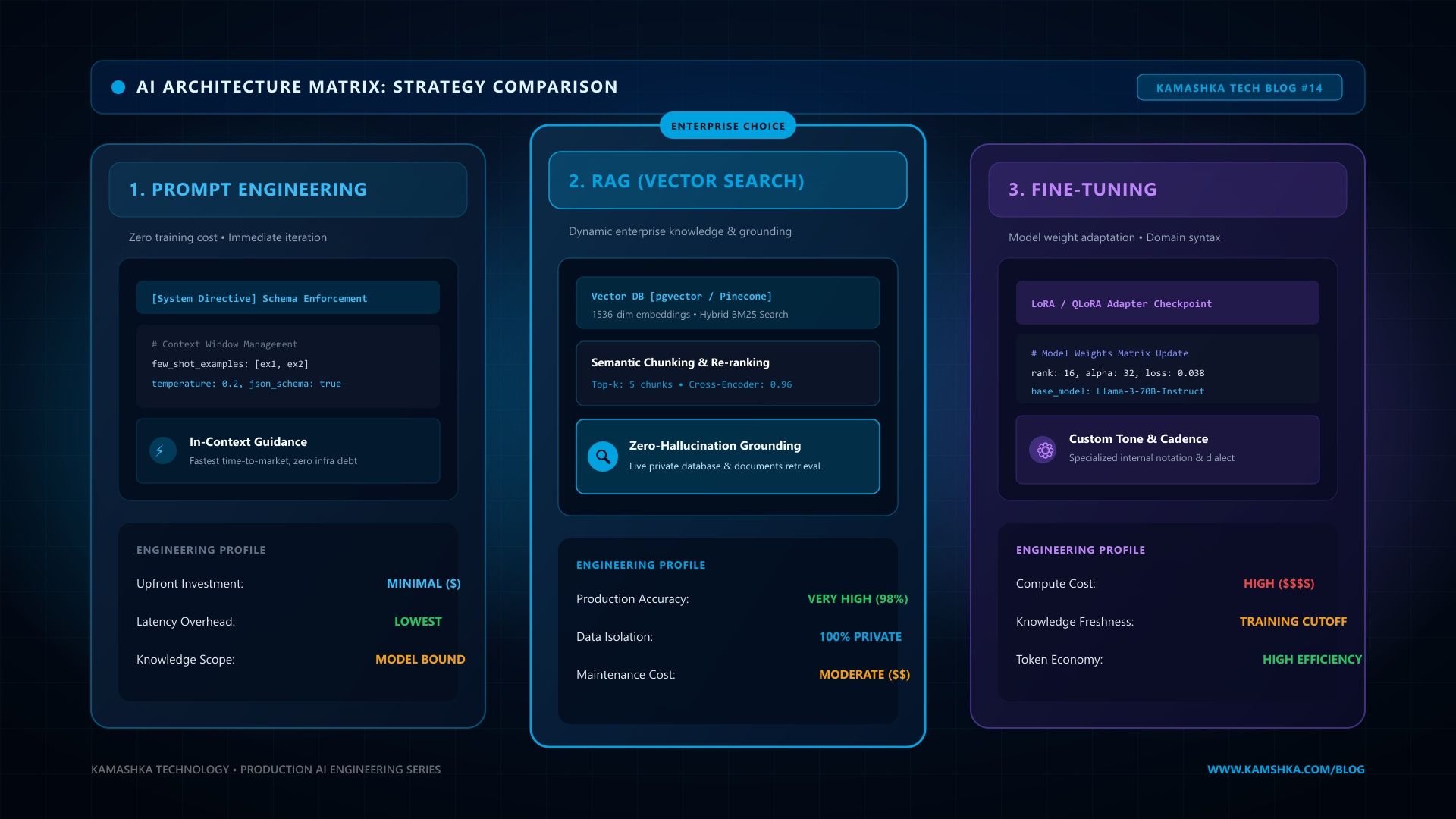
Every engineering team adopting Large Language Models eventually encounters the exact same executive request: "We want the AI to know our business." On its surface, the phrase sounds straightforward. But in software architecture, that single sentence is a dangerous ambiguity trap. Does "knowing your business" mean adhering to your JSON response schemas? Does it mean referencing 400 internal policy PDFs? Does it mean knowing the exact stock count of a laptop in your warehouse right now? Or does it mean adopting the specific diagnostic bedside manner of your senior technical support engineers? These are entirely different computer science problems. Conflating them leads to the most common architectural failure in modern enterprise AI: attempting to fine-tune a multi-billion-parameter neural network to solve a problem that required a simple SQL query, or bloating a system prompt to 80,000 tokens when all that was needed was a clean keyword index.
The Northstar Scenario: Anatomy of a Flawed AI Directive
Consider Northstar Technologies, a fast-growing B2B logistics SaaS platform. Northstar operates a complex enterprise stack: 300 internal policy and compliance documents, a dynamic knowledge base of shipping regulations, complex customer SLA pricing tier rules, a PostgreSQL database tracking real-time fleet telemetry and inventory, and 50,000 resolved customer support tickets.
During an executive strategy session, the VP of Product issues an urgent mandate: "Our competitors are launching generative AI assistants. We have all our documentation, tickets, and database schemas. Let's fine-tune a proprietary model on everything so our AI knows Northstar inside and out."
Two months and $65,000 later, Northstar's engineering team deployed their fine-tuned model into internal staging. The results were catastrophic:
- Current Inventory Hallucinations: When an account executive asked, "How many refrigerated cargo containers are available in Antwerp right now?", the model confidently answered "42 containers"—because it memorized a static report from a training snapshot taken six weeks earlier. In reality, the live inventory was zero.
- Catastrophic Policy Contradictions: When asked about international customs liability, the model synthesized an answer combining obsolete 2023 guidelines with 2026 regulations, creating an illegal compliance statement. Because the model weights permanently blended the text, there was no way to trace which document generated the answer.
- Authorization & Tenant Data Leaks: When an entry-level logistics clerk asked for shipping invoice templates, the model generated an example using real confidential pricing terms from Northstar's largest Fortune 500 client—data that had been indiscriminately included in the training corpus without tenant isolation.
- Unenforced Hard Limits: When prompted to calculate an emergency shipping discount, the model happily promised a 45% rate cut, violating Northstar's strict board-mandated 20% margin floor. The prompt contained instructions forbidding discounts over 20%, but the model simply prioritized the user's urgent phrasing over the prompt constraint.
Northstar did not have an AI capability problem; they had an architectural placement problem. The initial directive—"Fine-tune on everything"—treated a complex, distributed software challenge as a single monolithic machine learning task. When we decompose Northstar's requirements into their true computational primitives, the correct architecture becomes immediately obvious:
| Business Requirement | Flawed Initial Instinct | Actual Computational Primitive | Correct Architectural Mechanism |
|---|---|---|---|
| Product & Compliance Docs | Fine-tune model weights | Semi-static text retrieval with citations | RAG (Hybrid Semantic/Lexical Search) |
| Live Container Inventory | Fine-tune or Prompt injection | Authoritative real-time transactional state | Database Tool / API Function Call |
| Maximum Discount Caps (20%) | System prompt constraint | Non-negotiable business invariant | Deterministic Backend Rule Engine |
| Customer Account Info | Include in RAG index | Authenticated, tenant-scoped relational record | Authenticated Application API |
| Support Ticket Tone & Format | Fine-tune or 20-page prompt | Standardized response structure & style | Prompt + Few-Shot + Structured Output |
| Tenant Isolation Boundaries | System prompt instruction | Cryptographic / Relational Security Barrier | Row-Level Security & Application Auth |
The Core Thesis: Five Architectural Responsibilities
In enterprise software engineering, robust systems are defined by clear separation of concerns. The moment you introduce Large Language Models into your stack, this principle does not disappear—it becomes ten times more critical. The foundational architectural thesis of modern production AI is simple:
The Five Foundational Responsibilities of Production AI
- PROMPTS define operational instructions, schemas, and task framing.
- RETRIEVAL (RAG) provides dynamic, external, verifiable knowledge and evidence.
- TOOLS & APIS provide live transactional state and execute external side effects.
- FINE-TUNING adapts model behavior, output cadence, and specialized task execution.
- APPLICATION CODE guarantees deterministic business truth, security, and authorization.
- Using Prompts as a fake database leads to massive token bloat, high latency, and hallucinated facts.
- Using RAG for live state produces stale, unverified answers to real-time questions.
- Using Fine-Tuning to memorize facts creates un-updatable, un-auditable "black box" knowledge.
- Relying on AI Models to enforce security policies violates fundamental authorization boundaries.
- Expecting Base Models to follow complex proprietary schemas without structured constraints fails silently.
The Five-Bucket Framework for Classifying AI Requirements
Whenever an executive, client, or product manager says, "I need the AI to know X," you must immediately run X through the Five-Bucket Model. Each bucket represents a fundamentally different computational requirement that maps to a specific architectural layer:
Instructions & Framing
Semi-Static Knowledge
Live Transactional State
Specialized Task Behavior
User & Tenant Context
The Most Important Distinction: Knowledge Is Not Behavior
If you take only one concept from this architectural guide, let it be this: Knowledge is what an application references; behavior is how an application acts.
The most persistent myth in enterprise AI is the belief that fine-tuning is equivalent to "uploading your company's documents so the AI memorizes them." This mental model is profoundly flawed:
KNOWLEDGE (External / Dynamic)
Facts, policies, customer records, price sheets, regulatory standards, product catalogs.
BEHAVIOR (Internal / Stylistic)
Reasoning patterns, tone, dialect adaptation, shorthand syntax parsing, structural adherence.
When you attempt to force knowledge into model weights via fine-tuning, you lose source attribution, you make deletion and updates nearly impossible without full retraining, and you risk catastrophic hallucinations because neural networks generalize across statistical patterns rather than performing exact database lookups.
Prompt Engineering: Application Architecture, Not Creative Writing
In consumer circles, "prompt engineering" is often ridiculed as trying out clever adjectives until ChatGPT gives a pleasing answer. In enterprise software engineering, prompt engineering is an exact discipline: the design and construction of dynamic runtime execution contexts for non-deterministic inference engines.
A production prompt is not a static string written in a text file. It is an assembled data packet constructed at runtime from authenticated session variables, application state, few-shot examples, retrieved evidence, and strict output schemas:
{`interface ProductionPromptEnvelope {
  systemRole: string;           // "You are Northstar's Tier-2 Technical Triage Engine..."
  operationalConstraints: string[]; // ["Never promise SLA under 4 hours", "Cite Source ID for every claim"]
  structuredSchema: ZodSchema;  // Strict JSON output contract
  fewShotExamples?: Array<{    // Representative gold-standard demonstrations
    input: string;
    output: TriageClassification;
  }>;
  dynamicContext: {             // Runtime state assembled by application layer
    authenticatedTenantId: string;
    userRole: "ADMIN" | "OPERATOR" | "READONLY";
    retrievedEvidenceChunks: EvidenceChunk[];
    liveSystemStatus: SystemHealthSummary;
  };
  userQuery: string;            // Sanitized user input
}`}
The Danger of Prompt Bloat: Length $\neq$ Quality
The most common operational anti-pattern in teams relying solely on prompting is Prompt Bloat. It always starts innocently:
- The model fails an edge case in staging. A developer adds a warning paragraph to the system prompt: "Important: Never assume invoices under $500 require dual approval."
- Another edge case occurs next week. Another engineer appends three more rules: "If customer mentions shipping delay, apologize twice and check port codes."
- Three months later, the system prompt is 14,000 tokens long. It contains conflicting instructions, redundant guidelines, and stale company policies.
Prompt bloat causes three severe production failures:
- Attention Degradation ("Lost in the Middle"): Frontier LLMs suffer from positional bias. When prompts become massive, instructions placed in the middle of long contexts are frequently ignored or hallucinated over.
- Latency and Cost Inflection: Every single API request re-processes the entire prompt. At 15,000 tokens per request across 10,000 daily users, you are burning hundreds of dollars daily simply transmitting static guidelines.
- Instruction Conflicts: When Rule 4 says "Be as concise as possible" and Rule 19 says "Provide exhaustive diagnostic explanations for all technical terms", the model oscillates unpredictably.
RAG: Retrieval-Augmented Generation Demystified
Retrieval-Augmented Generation (RAG) is not a product; it is an architectural pattern. The core premise is elegant: instead of relying on the parameters of the neural network to hold facts, the application retrieves verifiable evidence from an external knowledge store at runtime and provides that evidence directly to the model inside the context window.
RAG Is a Distributed Pattern, Not Just "Upload PDFs to a Vector Database"
A common junior misconception is that RAG begins and ends with vector embeddings. In reality, retrieval is any mechanism that fetches relevant evidence for the prompt:
Exact keyword matching, error codes, part numbers, customer IDs, acronyms.
Semantic similarity, thematic concepts, paraphrased queries, multilingual intent.
Reciprocal Rank Fusion (RRF) combining BM25 lexical precision with vector semantic recall.
Structured filters, date ranges, tenant IDs, numerical aggregations, live status.
Entity-relationship traversal, dependency mapping, multi-hop legal or medical reasoning.
Authoritative external services, shipping carriers, live weather, credit checks.
The 11-Stage Production RAG Pipeline
A toy RAG script takes a PDF, splits it every 500 characters, calls OpenAI embeddings, and dumps vectors into a collection. A production-grade enterprise RAG pipeline is an engineered data flow with strict quality gates at every step:
The Production RAG Engineering Pipeline
🔒 AUTHORIZATION & TENANT ISOLATION PERIMETERDocument parsing, OCR, table extraction, header/footer stripping, metadata extraction.
Encoding fixes, markdown conversion, whitespace cleanup, HTML tag sanitization.
Document-aware splitting by section, paragraph, code block, or table rather than arbitrary token counts.
Tagging chunks with Tenant ID, Doc ID, Version, Updated Date, Author, Department, Security Clearance.
Generating dense vector embeddings while simultaneously creating sparse BM25 inverted lexical indexes.
Spelling correction, entity extraction, query rewriting, hypothetical document generation (HyDE).
Mandatory SQL/metadata pre-filter restricting retrieval strictly to the authenticated tenant and user role.
Executing parallel lexical and semantic searches across the authorized document subset.
Applying a specialized reranking model to score the top-50 candidates down to the top-5 most relevant chunks.
Deduplication, citation tagging, chronological sorting, and token budget packing for the prompt.
Base LLM generates answer strictly constrained to provided evidence, returning verifiable source references.
The Tenant Isolation Imperative in RAG
In our previous architectural guide on Multi-Tenant Data Isolation, we established that tenant boundaries must be enforced at the data layer, never the presentation layer. In RAG systems, this principle is absolute:
The LLM Is Not a Tenant Firewall
Querying a shared global vector index across all tenants, retrieving chunks from Tenant A and Tenant B, then instructing the LLM: "You are serving Tenant A. Ignore any chunks belonging to other tenants."
The application extracts the verified tenant_id from the JWT token and enforces a hard metadata filter in the database query before vector similarity is calculated: WHERE tenant_id = :tenant_id AND user_role IN (:roles).
The Data Lifecycle: "Delete Means Delete From Retrieval Too"
In enterprise applications, data is not permanent. Customers delete accounts, employees leave, documents are updated, and GDPR / compliance demands strict "Right to be Forgotten" workflows. If your engineering team deletes a customer contract from PostgreSQL or Amazon S3, but leaves the embedded chunks inside your vector database, you have created a critical data leak. The AI assistant can continue retrieving and quoting from the deleted document weeks after it was supposedly wiped.
Every document deletion workflow must trigger an automated event cascade:
{`async function handleDocumentDeletedEvent(event: DocumentDeletedEvent) {
  const { tenantId, documentId } = event;

  // 1. Delete source file from encrypted object storage
  await s3Client.deleteObject({ Bucket: tenantBucket(tenantId), Key: documentId });

  // 2. Delete metadata records from relational database
  await db.transaction(async (tx) => {
    await tx.delete(documentMetadata).where(eq(documentMetadata.id, documentId));
  });

  // 3. Purge all chunks and vectors from vector index
  await vectorStore.deleteMany({
    filter: {
      tenant_id: { $eq: tenantId },
      document_id: { $eq: documentId }
    }
  });

  // 4. Invalidate search caches and reranking candidate pools
  await redis.del(\`cache:rag:\${tenantId}:\${documentId}:*\`);
}`}
Multilingual RAG & Arabic Search Challenges
For technology platforms serving the MENA region (Egypt, Saudi Arabia, UAE, Qatar, Oman), multilingual retrieval introduces unique linguistic nuances that standard English tutorials completely ignore:
- Spelling Variation & Normalization: Arabic text exhibits widespread letter variations (e.g.,
أ / إ / آ / ا,ة / ه,ى / ي). A query searching for "إدارة الأزمات" will completely fail on unnormalized BM25 indexes containing "ادارة الازمات" unless robust morphological preprocessing is applied. - Mixed Arabic-English Technical Phrasing: Enterprise users across the Gulf and Egypt frequently mix English technical terms with Arabic grammar (e.g., "عايز أعمل ريفاند للأوردر ده عشان فيه ديفكت"). Embeddings models trained purely on formal Modern Standard Arabic (Fusha) struggle with colloquial technical code-switching.
- Cross-Lingual Retrieval: Often, the internal engineering manual is written in English, but the user submits a question in Arabic. Your embedding space must support cross-lingual semantic alignment, allowing an Arabic query to retrieve relevant English paragraphs without requiring expensive runtime translation of your entire knowledge base.
Fine-Tuning: Supervised Adaptation, Not a Database
Few topics in modern software are as misunderstood as fine-tuning. Let us state the foundational rule unambiguously: DO NOT USE FINE-TUNING AS YOUR LIVE DATABASE.
Fine-tuning is the process of adjusting the parameter weights of an existing foundation model by training it on a curated dataset of input-output pairs. It is designed to modify the model's behavior, style, syntactic consistency, or specialized reasoning patterns on a target task. It is not designed to serve as a reliable repository of factual information.
| Dimension | Prompt Engineering | Retrieval-Augmented Generation (RAG) | Supervised Fine-Tuning (SFT) |
|---|---|---|---|
| Primary Purpose | Task instructions, output schema, framing | Dynamic factual knowledge & evidence retrieval | Specialized behavior, style, task consistency |
| Knowledge Freshness | Static or dynamically injected per call | Sub-second (real-time index updates) | Frozen at training time; requires retraining |
| Source Attribution | N/A (model asserts from prompt) | Exact citations (document, page, paragraph) | None (facts diffused across billions of weights) |
| Data Privacy / Isolation | Session-scoped; ephemeral | Enforced via database RLS & metadata filters | Risky; model weights can memorize private training data |
| Setup Complexity | Low (minutes to hours) | Medium-High (indexing pipelines, chunking, search) | High (dataset curation, validation, training runs) |
| Ongoing Maintenance | Prompt versioning & regression tests | Index synchronization, chunk freshness, cache invalidation | Dataset curation, model re-evaluations, provider migrations |
When Fine-Tuning Actually Makes Sense
If fine-tuning is not for facts, when should an engineering team invest in it? Supervised fine-tuning is justified when your product demands extreme consistency on a specialized task that a base model cannot achieve even with comprehensive prompting and few-shot examples:
- Complex Domain-Specific Output Formatting: Transforming unstructured clinical doctor dictations into highly rigid, proprietary electronic health record (EHR) schemas where base models consistently make subtle structural errors.
- Token & Latency Optimization at High Volume: If your SaaS application processes 5,000,000 ticket classifications per month, including 2,000 tokens of few-shot examples in every single prompt creates massive latency and costs tens of thousands of dollars. Fine-tuning a smaller, faster model (e.g., an 8B parameter model) embeds those task patterns directly into the weights, allowing you to use a concise 50-token prompt and slash your inference bill by 80%.
- Unique Brand Tone & Dialect Adaptation: Training a conversational agent to strictly adhere to an authentic regional dialect (e.g., Egyptian or Gulf customer support phrasing) with vocabulary and cultural nuances that base models frequently dilute into generic Modern Standard Arabic.
- Specialized Translation & Parsing: Translating legacy internal domain languages (such as proprietary financial reporting DSLs or specialized ERP configurations) into modern JSON structures.
The Prerequisite: You Must Have an Evaluation Benchmark
The most common mistake teams make with fine-tuning is embarking on training before they have built an automated evaluation harness. If you do not have 100 to 500 gold-standard test cases with measurable scoring criteria, you cannot tell whether fine-tuning improved your product or degraded it.
Fine-tuning often introduces catastrophic forgetting or subtle regression: a model fine-tuned to classify support tickets may suddenly lose its ability to handle conversational pleasantries, or it may hallucinate more aggressively on edge cases outside the training distribution.
The Progressive Complexity Principle
In software engineering, complexity is a liability. Every new infrastructure component—whether a vector index, a reranking microservice, or a custom fine-tuned model checkpoint—introduces operational failure modes, deployment latency, monitoring overhead, and financial cost.
Therefore, every AI engineering initiative at Kamashka follows the Progressive Complexity Principle: Start with the simplest possible architecture, measure its performance against an automated evaluation set, and add architectural complexity only when an evaluated deficiency demands it.
The Architectural Progression Hierarchy
Advance to the next rung only when empirical evaluation proves the current rung is insufficientCapable Base Model + Clean Prompt
Write clear instructions, specify output format, define role and constraints. Test with a frontier base model.
Prompt + Few-Shot Gold-Standard Examples
Inject 3 to 5 realistic input-output examples into the prompt to demonstrate subtle formatting and edge-case handling.
Strict Schema Validation (Zod / JSON Schema)
Constrain model token decoding with provider-native structured outputs and runtime schema validation.
Function Calling to Authoritative Databases
If the model needs real-time state, user balances, or calculations, connect it to backend APIs and deterministic engines.
RAG (Hybrid Search + Metadata Filtering)
If the model needs access to large, dynamic, or private document knowledge, build an authorized retrieval pipeline.
Model Customization / Distillation
If and only if consistent task behavior remains inadequate across large evaluations, or token latency must be slashed at high volume.
Tools, APIs & Live Data: When AI Must Not Decide
In our previous architectural essay, Deterministic Logic + AI: Why Good Systems Shouldn't Let the LLM Decide Everything, we emphasized that probabilistic neural networks must never be permitted to execute financial calculations or enforce access controls.
When designing modern AI architectures, you must clearly distinguish between Retrieval (RAG) and Tool Calling:
| Mechanism | Type of Information | Computational Nature | Concrete Example |
|---|---|---|---|
| RAG (Retrieval) | Semi-static unstructured text | Probabilistic search + LLM synthesis | "What does Section 4 of our return policy say about opened electronics?" |
| Tool / API Call | Dynamic structured state | Deterministic query to authoritative DB | getOrderStatus(orderId: "ORD-9841") $\to$ "OUT_FOR_DELIVERY" |
| Deterministic Code | Non-negotiable business rules | Deterministic mathematical logic | if (order.total > 5000) requireDualSignoff(); |
If a user asks, "How much is this PC build right now?", you do not query an embedded PDF price list from last month, and you certainly do not ask the LLM to guess. Your application executes a tool call to the live inventory database, fetches the exact current price down to the cent, checks available stock, and hands that structured fact to the model solely to format the final explanation.
The Full Production Hybrid Architecture
Real-world enterprise systems are never "pure RAG" or "pure fine-tuning." Production systems are hybrid orchestrations where an intelligent router directs incoming requests to the appropriate subsystem, integrates live tools, applies deterministic guards, and validates outputs before returning them to the user.
Enterprise Hybrid AI System Architecture
DEFENSE-IN-DEPTH ORCHESTRATIONJWT / Session Token
Rate limits, tenant scoping, sanitization
Classifies request into computational primitives
Evidence packet + Citations + Schemas
Base Model (or Task-Fine-Tuned Checkpoint)
Schema validity + Business invariant check
The Architectural Decision Tree: Choosing Your Stack
Use this architectural decision tree to determine the exact mechanism your feature requires. Follow the branches from top to bottom:
AI Architecture Decision Flowchart
Map your functional requirement directly to the correct engineering pattern
System prompt instructions, Zod schema validation, and 3-5 few-shot demonstrations. Zero infrastructure overhead.
Document ingestion pipeline, chunking, tenant-scoped metadata filtering, hybrid BM25 + vector search, and reranking.
Database queries, REST API function calls, and transactional services. Never let the LLM guess live system state.
Standard TypeScript/SQL logic. Never delegate non-negotiable security or financial calculations to probabilistic tokens.
Curate 500+ gold-standard input-output pairs, establish automated evaluation benchmarks, and fine-tune for behavior/efficiency.
Evaluations: The Ultimate Architectural Arbiter
You cannot engineer what you do not measure. A team that chooses its AI architecture based on blog posts, vendor hype, or intuition will inevitably waste hundreds of engineering hours. The only rational way to build AI features is with a closed Diagnostic Evaluation Loop:
The Continuous AI Evaluation & Diagnosis Loop
DO NOT ADD INFRASTRUCTURE BEFORE YOU DIAGNOSE WHICH LAYER IS FAILINGDefine Evaluation Set
Assemble 100-300 realistic production scenarios with expected outputs, citations, and edge cases.
Establish Baseline
Run evaluation against a capable base model using a simple prompt and measure accuracy, latency, and cost.
Diagnose Failure Layer
Did retrieval fail to find the chunk? Did the model misread evidence? Did formatting break? Did tools time out?
Targeted Mitigation
Adjust the failing layer only: improve chunking for retrieval, schemas for formatting, or tools for live data.
Separate Retrieval Quality from Generation Quality
When a RAG-enabled feature generates an incorrect answer, junior developers often say: "The LLM hallucinated! We need a better prompt or a bigger model."
Experienced AI architects separate RAG evaluation into two independent metrics:
- Retrieval Quality (Recall & Precision@K): Did the search pipeline successfully retrieve the exact document chunk containing the truth? If the chunk was never retrieved, no prompt or foundation model in the world could have answered correctly without hallucinating. The failure belongs to your index, chunking, or search query rewriting.
- Generation Quality (Faithfulness & Groundedness): Given that the correct chunk was present in the prompt, did the model extract the truth accurately, or did it contradict the provided evidence? If it contradicted the chunk, the failure belongs to your prompt grounding, context framing, or model reasoning capacity.
The 10 Architectural Anti-Patterns of Enterprise AI
Avoid these ten pervasive architectural traps when designing your application's intelligence stack:
Fine-Tuning the Company Wiki
Attempting to bake changing internal documentation into model weights. Results in un-auditable facts and expensive retraining cycles.
The 80,000-Token System Prompt
Stuffing your entire company policy into every prompt instead of retrieving relevant sections. Causes high latency and attention drift.
Vectorizing the Entire Relational Database
Converting clean, structured SQL tables into vector embeddings. Destroys aggregation, filtering, and numerical precision.
RAG for Real-Time Inventory & Balances
Using semantic vector retrieval to check warehouse stock or account balances. Always use direct API/database tool calls for live state.
Fine-Tuning to Enforce Security Permissions
Training a model never to show confidential data. Vulnerable to jailbreaks and prompt injection. Authorization belongs in application code.
RAG Without Empirical Evaluation
Assuming that because you retrieved five chunks, they were the correct chunks. Always measure Recall@K against a benchmark dataset.
Fine-Tuning Without a Strong Baseline
Spending thousands on training before measuring what a capable base model achieves with structured outputs and few-shot examples.
One Monolithic Architecture for Every Feature
Forcing your search assistant, support triage, and analytics summarizer into the same architectural pattern. Match each feature to its primitive.
Using the Largest Frontier Model for Everything
Calling the most expensive reasoning model for trivial classification or simple sentiment extraction. Wasteful and introduces high latency.
"We Have RAG, So Hallucinations Are Solved"
Believing retrieval automatically guarantees factual generation. Models can still misread, combine, or extrapolate beyond evidence.
The Four Production Decision Checklists
Before committing engineering resources to an AI feature, run through the appropriate checklist below:
Is a Prompt Enough?
- Does the task rely on reasoning and general knowledge already present in the base model?
- Can all necessary instructions and examples fit comfortably within 2,000 tokens?
- Is the target output structure verifiable with standard JSON schema validation?
- Does the task require zero private company documents or dynamic external state?
- Can acceptable quality be achieved with 3 to 5 few-shot demonstrations?
Do I Need RAG?
- Does the feature require referencing private, proprietary, or domain-specific documents?
- Is the total volume of reference material too large to fit in every request prompt?
- Do documents update regularly without requiring changes to the model?
- Do users require verifiable source citations and page-level provenance?
- Can document access be strictly restricted using tenant and role metadata filters?
Do I Need a Tool or API?
- Does the question depend on live, sub-second transactional database state?
- Does the action require side effects (e.g., booking an appointment, sending an email)?
- Does the answer require mathematical precision or complex aggregation (e.g., sum of invoices)?
- Is there an existing authoritative backend REST/GraphQL service or SQL database?
- Must the execution be protected by transactional database guarantees and rollback?
Do I Need Fine-Tuning?
- Have you rigorously tested a frontier base model with few-shot prompting and structured output?
- Do you have an automated benchmark evaluation set of at least 200 gold-standard cases?
- Is the problem strictly one of task behavior, style, or syntax rather than missing knowledge?
- Do you have at least 500 to 2,000 clean, human-verified, privacy-sanitized training pairs?
- Will fine-tuning a smaller model significantly reduce token cost and latency at high scale?
Six Concrete Enterprise Case Studies
To see how these architectural boundaries function in production, let us examine six end-to-end case studies across different industry verticals:
Northstar HR & Compliance Knowledge Assistant
The Problem: 2,000 employees asking questions about health insurance, maternity leave, travel allowances, and IT security guidelines across 400 internal PDFs.
- Tenant & Role Filter: Employee's verified department and country code pre-filter the document index (e.g., Egyptian employees only retrieve Egyptian labor policy).
- Hybrid RAG: BM25 keyword matching for exact policy clauses + dense vector embeddings for semantic intent.
- Strict "No Evidence" Guard: If retrieved chunk similarity falls below threshold, system returns: "I could not find an authoritative policy covering this scenario. Please contact HR at hr@northstar.internal."
- Zero Fine-Tuning: Handbooks change quarterly; updating a vector index takes seconds, whereas retraining weights would be unmanageable.
Automated Inbound Support Triage Engine
The Problem: Classifying 200,000 incoming customer messages per month into four categories (BILLING, TECH_ISSUE, ACCOUNT_ACCESS, SALES) with required priority tags.
- Phase 1 (MVP): Base model + system prompt + 4 few-shot examples + Zod schema validation. Achieved 94% accuracy.
- Phase 2 (Scale Optimization): High token volume at 200k calls/month was costly. Team curated 2,000 historical human-verified classifications and fine-tuned a lightweight 8B parameter model.
- Result: Accuracy rose to 97.4%, prompt token overhead dropped from 1,200 tokens to 80 tokens, and latency dropped from 1,800ms to 240ms.
Intelligent Hardware & Gadget Shopping Concierge
The Problem: A user asks: "Find me a gaming laptop with an RTX 4070 under 55,000 EGP that is in stock right now and can deliver to New Cairo tomorrow."
- Intent Extraction: LLM parses natural language into structured parameters:
{`{ gpu: "RTX 4070", maxPrice: 55000, inStock: true, location: "New Cairo" }`}. - Database Tool Call: Executes structured SQL query directly against the real-time PostgreSQL product and inventory database.
- Zero Vector Search for Pricing: Prices, discounts, and inventory counts are never embedded in vectors.
- Response Generation: LLM takes the structured database result and crafts an engaging, natural-language recommendation.
Regional Pipeline Sales Assistant
The Problem: A sales director asks: "Show me all enterprise leads in Riyadh that haven't received a follow-up in 10 days, and summarize their primary objections."
- SQL Tool Execution: Application queries CRM relational tables filtered by
region = 'Riyadh'andlast_contact_date <= NOW() - INTERVAL '10 days'. - RBAC Verification: Validates sales director has authorization to view those specific accounts.
- RAG on Interaction Notes: Retrieves recent call transcripts and meeting notes for those specific accounts.
- Synthesis: LLM summarizes common objection themes across the retrieved transcripts with account citations.
Paid Time Off (PTO) Carry-Over Calculator
The Problem: An employee asks: "Can I carry over my 6 unused vacation days into next year?"
- RAG: Retrieves the official corporate PTO carry-over clause from the employee handbook (e.g., maximum 5 days carry-over allowed).
- Database API: Fetches employee's exact current balance (6 days remaining) and employment tier.
- Deterministic Engine: Compares balance against policy maximum:
carryOver = Math.min(balance, 5)$\to$ 5 days carry over, 1 day expires or cashes out. - LLM Role: Clearly explains the policy clause and presents the calculated breakdown with absolute mathematical certainty.
Kamashka PC Build Architecture Engine
The Problem: A user inputs seven components and asks: "Is this build compatible, will the cooler fit my case, and where is the performance bottleneck?" (Referencing our PC Parts Architecture Guide).
- Hardware Specifications DB: CPU socket type (LGA 1700), motherboard chipset, RAM generation (DDR5), cooler height (160mm), and case clearance (165mm) fetched deterministically.
- Deterministic Compatibility Engine: Hard rule evaluation: Socket matches? DDR generation matches? PSU wattage > estimated TDP + 20%?
- RAG (Technical Manuals): Retrieves motherboard VRM layout documentation to verify clearance around tall heatsinks.
- LLM Narrative Synthesis: Explains the engineering trade-offs, thermal headroom, and component synergy in accessible, professional language.
Conclusion: The Best AI Architecture Has the Least Unnecessary AI
Throughout this five-part AI Engineering Series, we have examined the reality of building production artificial intelligence systems:
- In Blog #10 (AI Agents vs Traditional Automation), we established that autonomy is an expensive engineering liability, and deterministic state machines should always handle predictable business workflows.
- In Blog #11 (How to Add AI to a SaaS Product Without Making AI the Entire Product), we demonstrated how to embed intelligence as a pragmatic feature layer while keeping core business data and tenant boundaries immutable.
- In Blog #12 (Deterministic Logic + AI: Why Good Systems Shouldn't Let the LLM Decide Everything), we introduced the Three-Zone architectural model and the AI Sandwich pattern, proving that code must always enforce business truth.
- In Blog #13 (Building Reliable AI Features: Rate Limits, Fallback Models and Failure Handling), we architected for inevitable third-party API outages with multi-dimensional rate limiting, jittered backoff, circuit breakers, and fallback ladders.
- And here in Blog #14, we close the series by putting every customization and retrieval mechanism in its proper computational place.
The Foundational Truth of Enterprise AI Engineering
The best AI architecture is not the one with the most AI. It is the one that assigns each computational responsibility to the layer best equipped to guarantee correctness, security, cost efficiency, and speed.
When instructions belong in prompts, keep them in prompts. When knowledge belongs in documents, retrieve it with RAG. When state lives in databases, query it with APIs. When rules are non-negotiable, write them in code. And when specialized task behavior demands it, evaluate fine-tuning with empirical rigor.
Planning to Implement AI Agents or Modern Automation?
Bridging deterministic business workflows with autonomous AI agents requires rigorous architectural boundaries, tool encapsulation, rate limits, and human-in-the-loop oversight. Kamashka designs and builds production-grade, reliable AI and software automation systems.
The Production AI Architecture & Engineering Series
A 5-part engineering series exploring agent autonomy boundaries, pragmatic SaaS integration, deterministic safeguards, operational reliability, and architectural choices.
An architectural guide evaluating deterministic workflows vs agentic decision loops, error cost matrices, and autonomy budgets.
An architectural guide to integrating AI while preserving deterministic business rules, tenant boundaries, and RBAC security.
Why production systems enforce deterministic business rules around probabilistic models, the Three-Zone model, and the AI Sandwich pattern.
Architecting for API outages, tiered model cascades, graceful degradation, and idempotency in AI pipelines.
A pragmatic architectural guide evaluating retrieval, specialized fine-tuning, prompt engineering, and live tools.