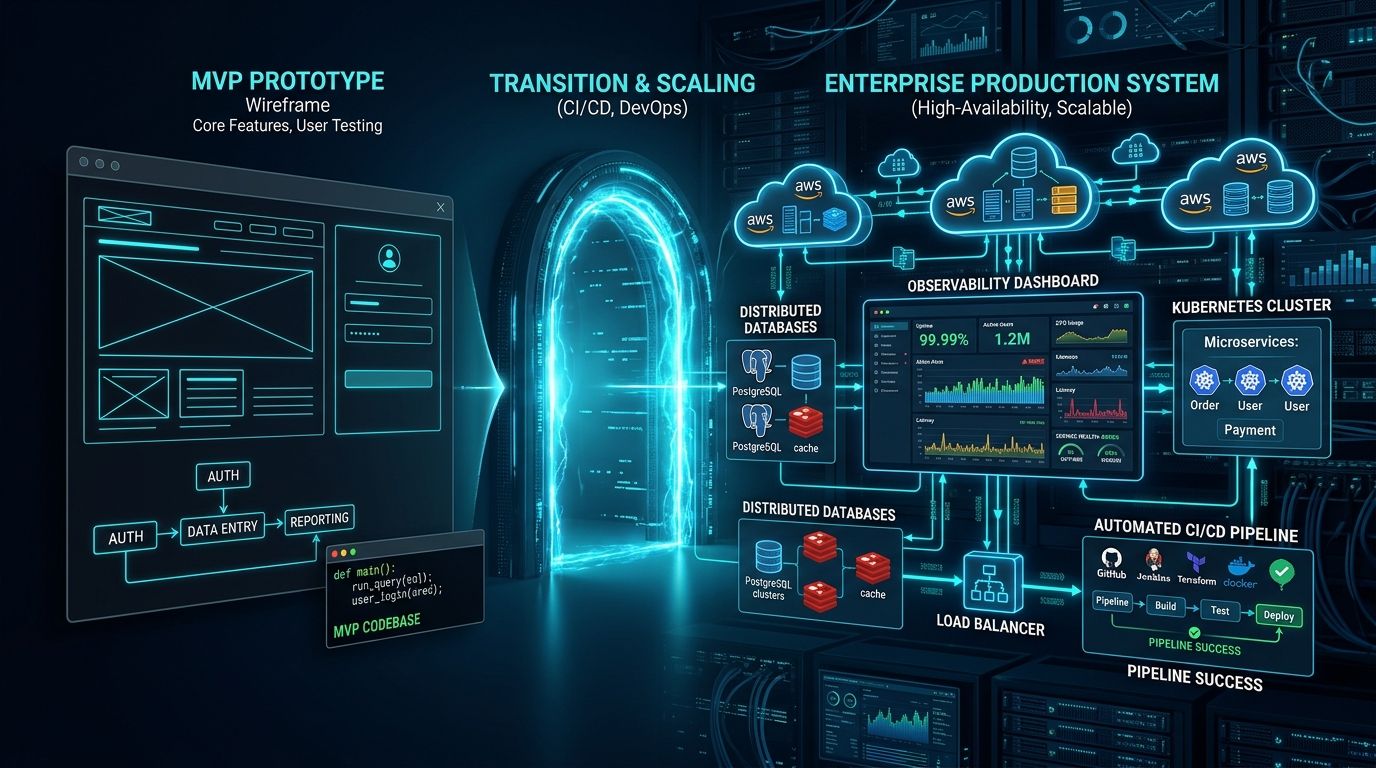
The demonstration meeting was an unambiguous triumph. You set up a fresh test account, created a new workspace, invited a colleague by email, watched the invitation notification land in their inbox within seconds, uploaded a sample project asset, and walked through the primary workflow without a single hitch. The charts on the live analytics dashboard refreshed instantly, the test payment webhook cleared with a bright green banner, and everyone in the room nodded in agreement. The Minimum Viable Product (MVP) was complete. The team celebrated, and the decision was made: "Let's launch to production next week."
Then, real users arrived.
Within seventy-two hours of opening access, reality began asserting itself in ways that never appeared during controlled internal testing. An eager customer on a congested mobile connection tapped the "Submit Order" button, saw the spinner pause for three seconds, and tapped it three more times—triggering four separate credit card authorizations. A regional email provider experienced a temporary fifteen-minute routing outage, causing your synchronous user onboarding endpoint to time out and crash with HTTP 504 errors. Two workspace administrators simultaneously edited the same team invoice from different offices, silently overwriting each other's line items. A routine database migration executed cleanly in staging but locked a high-traffic production table for forty-five seconds because nobody tested it against half a million existing rows containing legacy NULL values. An analyst requested an unfiltered CSV export of six months of transactional activity, consuming all available server RAM and triggering an out-of-memory crash across unrelated background processes.
At that exact moment, the engineering question changed forever. During the MVP phase, the question was: "Can we make the primary workflow work?" In production, the question becomes: "Can we keep that workflow operating safely, reliably, and predictably when the physical world stops cooperating?"
In software engineering, "it works" is the starting line of production readiness, not the finish line. Moving from an MVP to production is never about throwing away your code and rewriting everything from scratch; it is about systematically identifying and eliminating unacceptable operational risk.
- Authentication hardening & session revocation
- Tenant isolation across all data stores (RLS)
- Environment variable & secrets rotation
- Strict browser security headers (CSP, HSTS)
- Idempotency keys for non-duplicate writes
- Optimistic concurrency & database constraints
- Timeouts, backoff & circuit breakers
- Dead-letter queues for failed async tasks
- Backward-compatible migrations (Expand/Contract)
- Regularly tested restore drills (RPO/RTO)
- Tenant data offboarding & retention rules
- Direct-to-storage pre-signed file uploads
- Structured JSON logging with request IDs
- Actionable alerting without notification fatigue
- Distributed tracing across APIs & workers
- Differentiated shallow and deep health checks
- Reproducible CI/CD container builds
- Strict environment isolation (Dev / Staging / Prod)
- Independent application & database rollbacks
- Feature flags & emergency kill switches
- Least-privilege administrative tools
- Never using production DB as an admin UI
- Comprehensive operational incident runbooks
- Bounded queries & cursor-based pagination
MVP Does Not Mean Bad Code: Known Shortcuts vs. Forgotten Shortcuts
A damaging misconception among startup founders and engineering teams is the belief that "MVP" is synonymous with sloppy code, absent security, and disposable architecture. It is not.
A Minimum Viable Product intentionally constrains scope, not engineering competence. An MVP decides to implement only three features instead of thirty; it does not decide to store unencrypted passwords or bypass database constraints. However, in the race to validate product-market fit, every engineering team makes tactical compromises to accelerate delivery. The crucial distinction that determines whether a codebase survives the transition to production is whether those compromises are Known Shortcuts or Forgotten Shortcuts:
- A Known Shortcut: The team intentionally defers a complex operational capability—such as asynchronous background queues or cursor pagination—because current throughput is low. The limitation is documented in code comments, architectural decision records, and backlog tickets, with clear trigger criteria for when it must be refactored.
- A Forgotten Shortcut: An engineer writes a temporary synchronous HTTP call to an external vendor, hardcodes an environment configuration, or skips a unique constraint on a relational table to fix an immediate bug. Nobody documents it. Three months later, when the original author is on vacation and production traffic spikes, the forgotten shortcut triggers an invisible, cascading system outage.
Preparing for production does not require rebuilding your application from scratch. It requires taking an exhaustive, honest inventory of your shortcuts and systematically hardening the ones that represent unacceptable operational risk.
Phase 1: The Pre-Production Risk Inventory
Before writing a single line of infrastructure code or provisioning enterprise cloud services, step away from the IDE and audit your application against operational reality. Ask these foundational diagnostic questions:
- What operations are manual? If running a database migration, deploying a patch, rotating a compromised key, or provisioning a new customer requires an engineer to execute manual commands from their terminal, that process is a single human mistake away from a catastrophic incident.
- What dependencies fail silently? Which third-party APIs (Stripe, Twilio, SendGrid, OpenAI) have zero timeouts or fallback logic? If their latency jumps from 200ms to 15 seconds, will your application server exhaust its connection pool and lock up?
- Which queries assume empty or tiny tables? Did local testing only query twenty rows? What happens when a customer's workspace contains 250,000 records?
- Which operations cannot be safely retried? If a background job or webhook handler dies halfway through execution, will retrying it create duplicate billings, double-send onboarding emails, or corrupt inventory counts?
- Where are single points of failure concentrated? Does only one senior engineer have access to the production DNS records, cloud billing dashboard, or root database credentials?
The Demo Happy Path
Linear / FragileClient submits order payload over fast, stable office Wi-Fi.
Backend updates database, charges credit card, and sends confirmation email in a single block.
Everything succeeded without a single hiccup. Perfect demo.
The Real Production Path
Defensive / BranchedIdempotency-Key header; return cached response if already processed.
Environment Architecture: The Iron Wall Between Environments
In an early-stage project, boundaries between environments are notoriously porous. Developers run test scripts against staging databases that share external service credentials with production, or worse, use live production database dumps on their local development laptops to troubleshoot tricky bugs.
Production engineering requires strict, non-negotiable separation across three primary tiers:
- Development (Local): Optimized for developer velocity, instant hot-reloading, and rapid iteration. Backed by local dockerized containers, synthetic seed data, and mocked third-party APIs.
- Staging (Pre-Production): An exact structural mirror of production infrastructure. Staging must run identical container configurations, the exact database engine version, and run automated CI/CD deployment routines. Staging exists to validate that deployment pipelines, schema migrations, and external integrations behave identically to production without putting live customers at risk.
- Production: The sanctum of real users, live money, and confidential commercial records. Access is heavily restricted, logged, and audited.
The Iron Rule of Environments: Non-production environments must never, under any circumstance, possess credentials capable of reading, modifying, or interacting with production resources. A staging environment with access to a production Stripe webhook secret, Amazon S3 bucket, or SendGrid API key will inevitably charge real customers during an integration test or send "Test Message 123" to thousands of paying enterprise clients.
Configuration vs. Secrets Management
Architecture must maintain a rigorous distinction between Application Configuration and Cryptographic Secrets:
- Configuration: Non-sensitive metadata that dictates behavior across environments—such as log verbosity (
LOG_LEVEL=debugvs.info), base API domains (https://api.kamshka.com), pagination limits, and feature toggles. These can safely exist in environment definition files. - Secrets: High-entropy cryptographic material, database passwords, OAuth client secrets, private signing keys, and third-party API tokens.
Secrets must never be committed to a Git repository, even in private repositories. A secret committed to Git history must be treated as permanently compromised: deleting the commit or pushing a subsequent cleanup commit does not eliminate the risk, as the credential persists in git references, clones, and local developer caches. If a secret ever touches source control, the only secure remediation is to immediately revoke and rotate the key at the provider level.
Database Migrations in Production: Escaping the Empty Database Trap
During MVP development, database schema changes are trivial. When an entity relationship changes or a new column is added, an engineer runs:
# The dangerous MVP workflow
npm run db:drop && npm run db:migrate && npm run db:seed
In production, dropping tables or casually altering schemas is not an option. You are operating on irreplaceable customer records, active read-write traffic, and mission-critical transactions.
The Empty Database Trap
The most seductive illusion in software testing is running a database migration against a clean, empty local database and watching it succeed in four milliseconds. An empty database proves virtually nothing about how that migration will perform in production:
- Table Locking: Executing
ALTER TABLE orders ADD COLUMN status VARCHAR NOT NULL DEFAULT 'pending';on PostgreSQL may instantly succeed locally with 50 rows. On a production table with two million records, that statement can acquire an exclusive table lock (ACCESS EXCLUSIVE), blocking all reads and writes until every existing row is rewritten on disk, causing your API gateways to time out and crash. - Legacy NULL Values: Adding a
NOT NULLconstraint to an existing column will immediately fail and abort the migration if even a single legacy row created six months ago contains aNULL. - Index Creation Overhead: Creating an index on an active table without the
CONCURRENTLYkeyword blocks incoming writes until the index scan finishes.
The Expand → Migrate → Contract Pattern
To deploy database changes to active multi-tenant platforms without downtime, production engineering relies on the phased Expand → Migrate → Contract strategy:
- Phase 1: Expand (Non-Breaking Schema Addition): Add the new column, table, or nullable constraint alongside the existing schema. Do not remove or rename old columns. The currently running production code continues reading and writing to the old structure without interruption.
- Phase 2: Dual-Writing Application Release: Deploy an application update capable of writing to both the old and new structures, while reading from the old structure with fallback logic.
- Phase 3: Backfill Background Migration: Execute a rate-limited, asynchronous background worker that iterates through existing historical records in small batches (e.g., 500 rows at a time) to migrate data into the new structure without generating transaction locks.
- Phase 4: Switch Reads: Deploy an application update that switches primary reads to the newly populated structure.
- Phase 5: Contract (Cleanup): After monitoring metrics and verifying data integrity for several release cycles, safely drop the deprecated column or table in a subsequent non-critical deployment.
Backups Are Not Enough: Tested Restores and Business RPO/RTO
Log into almost any cloud database console, and you will see a reassuring green checkmark labeled: "Automated Daily Backups: Enabled."
Having backups configured is comforting, but a backup strategy is completely unproven until a restore has been successfully executed and timed. The technology industry is filled with cautionary tales of companies that faithfully collected database snapshots for years, only to discover during an existential hardware failure that their snapshots were corrupted, their decryption keys were lost, or their restoration script failed due to an outdated dependency.
Production readiness requires defining and testing two vital operational metrics:
- Recovery Point Objective (RPO): How much recent data loss can the business tolerate in the event of catastrophic hardware failure? If backups occur once every 24 hours at midnight, an outage at 11:59 PM represents twenty-four hours of permanently lost customer transactions. If the business can only tolerate five minutes of loss, continuous Point-In-Time Recovery (PITR) with Write-Ahead Logging (WAL) archiving is an architectural requirement.
- Recovery Time Objective (RTO): How long can the system remain completely offline before recovery becomes unacceptable? Restoring a 500GB database snapshot across network volumes might take four hours. If your customer SLAs promise 99.9% availability, four hours of unplanned downtime consumes your entire quarterly error budget in a single afternoon.
Schedule periodic, automated Restore Drills into an isolated staging environment to verify that snapshots can be decrypted, restored, and verified without human panic.
Feature Complete (The MVP)
Case Study: CSV Bulk Customer Import
- ✅ User selects a CSV file from their file system.
- ✅ Frontend sends file to
POST /api/import. - ✅ Server parses rows and runs
db.insert(). - ✅ Response returns
200 OK: "Imported successfully!"
Operationally Complete (Production-Ready)
Case Study: CSV Bulk Customer Import
- 🛡️ Auth & Tenant Ownership: Verify user membership, permission, and target tenant workspace before accepting payload.
- 📦 Direct Storage Upload: Stream directly to private S3 via pre-signed URL; prevent web server memory exhaustion.
- ⚡ Asynchronous Queue: Enqueue job to background worker; return fast
202 Acceptedwith job tracking ID. - 🔄 Idempotency Protection: Prevent duplicate processing if user re-submits or clicks twice.
- ⚠️ Graceful Partial Failure: If row 3,842 fails validation, report row-specific errors without crashing the entire batch.
- ⏳ Progress & Status Visibility: Realtime WebSocket or polling endpoint displaying percent complete to the user.
- 🔒 Composite DB Constraints: Ensure imported records strictly enforce tenant boundaries and foreign keys.
- 🧹 Artifact Lifecycle: Schedule automatic purging of temporary uploaded CSV files after 48 hours.
- 📡 Structured Telemetry: Log
request_id,tenant_id, row count, and execution duration for support visibility. - 🛠️ Admin Diagnostics: Provide support staff with a dashboard to inspect and safely retry failed import jobs.
The Anatomy of Real-World Errors: User-Facing vs. Internal Diagnostics
In early prototypes, error handling usually looks like this:
// The naive MVP try/catch block
try {
  await processPayment(user, cart);
} catch (error) {
  res.status(500).json({ error: "Something went wrong. Please try again." });
}
When a paying customer encounters this error in production, they submit a support ticket saying: "Payment failed." Customer support turns to engineering. Engineering opens the server logs, only to find hundreds of identical lines reading "Something went wrong" with no timestamps, no user IDs, no stack traces, and no contextual clues.
Production architectures enforce a strict bifurcation between User-Facing Error Presentation and Internal Diagnostic Telemetry:
- User-Facing Errors Must Be Helpful, Non-Disclosing, and Actionable: Never leak database table names, SQL queries, internal IP addresses, stack traces, or authentication secrets to the client browser. Doing so violates security standards and helps attackers map internal vulnerabilities. The user should see: "We couldn't process your card. Please verify your billing postal code and try again."
- Internal Diagnostics Must Be Rich, Structured, and Traceable: The server must log a structured JSON event containing an immutable
request_id, the activetenant_id, the user ID, timestamp, the specific external provider error code (e.g.,stripe_card_declined_zip_check), and latency. The frontend can display: "Reference Code: req_8f9c1b2", allowing support staff to instantly find the exact log line in centralized logging systems.
Observability: Structured Logging, Metrics, and Alert Fatigue
Observability is the capacity to infer the internal states of a system based solely on its external outputs. When a distributed SaaS platform operates in production, you cannot attach an interactive debugger or reproduce every user action locally.
Mature production observability is built on three complementary signals:
1. Structured Logging
Plain-text console output like console.log("Error in worker") is virtually useless when processing millions of operations. Production systems emit structured JSON logs that can be indexed, filtered, and aggregated by log management engines:
{
  "timestamp": "2026-09-28T16:42:01.892Z",
  "level": "error",
  "event": "invoice_generation_failed",
  "request_id": "req_c9481b0a-42",
  "tenant_id": "org_acme_industries",
  "user_id": "usr_77192",
  "duration_ms": 1420,
  "error_code": "PDF_RENDER_TIMEOUT",
  "attempt": 2
}
As established in our deep dive on Multi-Tenant Data Isolation, logs are part of your security boundary. Structured logs must automatically redact credit card numbers, passwords, authorization tokens, and personal customer data.
2. Correlation & Request IDs
In modern cloud architectures, a single user click triggers a cascade across multiple components: an API Gateway, an authentication middleware, a relational database, an in-memory cache, an asynchronous message queue, and an external email service.
Every incoming HTTP request must be assigned a unique Request-ID at the ingress gateway. This correlation identifier must propagate down every function call, database transaction, and background job message payload. When an error occurs, engineers can filter by that single ID to reconstruct the complete chronological journey of the request across all microservices.
3. Actionable Alerting vs. Alert Fatigue
Many engineering teams believe that "good monitoring" means setting up alerts that ping their team Slack or PagerDuty whenever any metric spikes. Within two weeks, the team receives 200 alerts a day for transient CPU blips, benign network retries, and routine web crawlers. The inevitable human outcome is alert fatigue: engineers mute the channel, and when the real database failure occurs, nobody notices.
Effective production alerts adhere to three rules:
- Alert on Symptoms, Not Underlying Causes: Do not alert because CPU reached 85%. Alert when user-facing
5xxerror rates exceed 1%, or when p95 response latency exceeds acceptable thresholds. - Every Alert Must Be Actionable: If an engineer receives an alert, there must be a clear, documented procedure (a runbook) specifying what action needs to be taken. If an alert requires no action, delete it.
- Health Check Differentiation: Separate shallow liveness checks (verifying that the Node.js process is responsive) from deep readiness checks (verifying database connectivity, Redis connection pools, and queue responsiveness before routing traffic to an instance).
The Law of Idempotency: Double-Click Protection Is Not Enough
One of the most consequential concepts separating amateur software from production-grade engineering is Idempotency.
An operation is idempotent if performing it multiple times with the same parameters produces the exact same system state as performing it once. In a mathematical sense: f(f(x)) = f(x).
Consider this common scenario: A user clicks "Pay $500". The server receives the request, processes the credit card transaction through Stripe, and writes the receipt to the database. But before the HTTP response travels back over the internet, the user's mobile cellular connection drops. The browser displays a connection error. The user naturally clicks "Try Again".
If your endpoint is not idempotent, the user gets billed $1,000 for a single purchase.
Why Frontend Button Disabling Fails
Frontend developers often claim: "We disabled the button on click, so users can't submit twice." This provides basic UX feedback, but it provides zero architectural protection against:
- Users opening the same checkout page in two different browser tabs.
- Network timeouts where the client library automatically retries the HTTP request.
- Asynchronous background workers retrying a job envelope after a temporary database blip.
- Payment webhook redeliveries from providers like Stripe or PayPal.
Critical state-changing mutations must enforce idempotency at the server and database tier using Idempotency Keys:
// Handling an Idempotent API Request
export async function handleOrderCreation(req: Request) {
  const idempotencyKey = req.headers.get("Idempotency-Key");
  if (!idempotencyKey) {
    return new Response("Missing Idempotency-Key header", { status: 400 });
  }

  // 1. Check if we have already processed this exact key for this tenant
  const existingRecord = await db.idempotencyRecords.findUnique({
    where: { tenant_key: `${tenantContext.id}:${idempotencyKey}` }
  });

  if (existingRecord) {
    // Return the cached original response without re-executing billing logic!
    return new Response(existingRecord.responseBody, { status: existingRecord.statusCode });
  }

  // 2. Execute transaction atomically with composite uniqueness constraint
  return await db.$transaction(async (tx) => {
    const order = await tx.orders.create({ ... });
    await tx.idempotencyRecords.create({
      data: {
        tenant_key: `${tenantContext.id}:${idempotencyKey}`,
        statusCode: 200,
        responseBody: JSON.stringify(order)
      }
    });
    return order;
  });
}
The Resilient Background Worker Lifecycle
How asynchronous tasks must be queued, executed, retried, and isolated in production.
Durable Envelope
Job payload is persisted in a durable broker (Redis/RabbitMQ/SQS) with verified tenant_id and request_id metadata.
Isolated Worker
Worker node dequeues job, locks execution, sets timeout boundaries, and initializes tenant context.
State Committed
Task finishes successfully; artifacts uploaded, audit trail written, metrics updated, and job acknowledged.
Dead-Letter Queue
If transient retries exhaust exponential backoff limits, job routes to Dead-Letter Queue with high-severity support alert.
Concurrency Control: Optimistic Locking and State Machine Transitions
In an MVP tested by a single developer on a local machine, operations happen sequentially. In production, hundreds of users interact with shared entities at the exact same millisecond.
The Lost Update Problem
Imagine an invoice approval workflow. Administrator A opens Invoice #402. Two seconds later, Administrator B opens the same invoice. Administrator A updates the payment terms to "Net 60" and clicks Save. Moments later, Administrator B (who is still looking at the original screen) changes the shipping address and clicks Save.
Without concurrency control, Administrator B's save completely overwrites Administrator A's payment terms updates. Nobody receives an error, but critical business data was silently destroyed.
Production architectures resolve this through Optimistic Concurrency Control (OCC). Every mutable record carries a version counter:
-- Safe concurrent update using version checking
UPDATE invoices
SET terms = 'Net 60', version = version + 1
WHERE id = :invoice_id
  AND tenant_id = :tenant_id
  AND version = :expected_version;
If another user modified the row in the interim, the database updates zero rows. The application detects this, rejects the second mutation, and prompts the user: "This invoice was modified by another administrator while you were editing. Please refresh to review the latest changes."
Explicit State Machine Transitions
Similarly, entity statuses must not be treated as arbitrary strings. An invoice or order lifecycle follows strict directional rules:
DRAFT ➔ PENDING_PAYMENT ➔ PAID ➔ FULFILLED
   ↳ CANCELLED
Can a CANCELLED order transition back to PAID? Can a FULFILLED order transition back to DRAFT? Production backends enforce strict state-transition guards, rejecting invalid jumps at the domain layer regardless of what client requests submit.
Deterministic CI/CD & Release Verification Pipeline
Removing human deployment variance through automated, repeatable release gates.
Deployments and Rollbacks: Why App Rollback ≠ Database Rollback
An MVP deployment often consists of an engineer connecting to a server, running git pull, and restarting a process.
Production requires Reproducible Deployments through Continuous Integration and Continuous Delivery (CI/CD). Every build must be deterministic, utilizing pinned dependency lockfiles (such as package-lock.json) to eliminate the dreaded "it works on my machine" syndrome.
The Rollback Fallacy
When a release introduces a severe regression in production, the immediate instinct is: "Hit the rollback button in Vercel or AWS!"
However, rolling back your application code does not roll back your database schema. If your deployment executed a destructive database migration—such as dropping a column or renaming a key table—rolling back your code to the previous Git commit will immediately break the old version of the application, because the old code expects the previous schema that no longer exists!
This is why the Expand → Migrate → Contract pattern is essential. Code and database releases must remain decoupled. Your database schema must always remain backward-compatible with both the currently running application release and the previously deployed release, ensuring that an emergency code rollback can proceed without schema panic.
Disaster & Degraded Operations Architecture
How the system must behave when individual components experience severe failure.
| Failure Scenario | System Degradation Behavior | Automated Mitigation & Recovery Strategy |
|---|---|---|
| Primary Database Unavailable | Read/write operations halt; display user-friendly maintenance banner. | Automated failover to read-replica; circuit breakers prevent connection pool exhaustion. |
| Email Provider Outage (SendGrid/Resend) | User registration succeeds; verification email is delayed. | Transactional emails buffered in durable queue with exponential backoff retries. |
| Cloud Object Storage Down (S3) | File upload/download buttons display temporary unavailable state. | Pre-signed URL generation fails gracefully with retry recommendations; core data remains intact. |
| External AI Provider Outage (OpenAI/Anthropic) | AI features disable gracefully; core workflows continue. | Timeout enforcement (10s); circuit breaker prevents cascading latency; fallback to deterministic rules. |
| Corrupted Code Deployment | Elevated 5xx error rate or failed health checks detected. | Automated rollback to previous stable container image; zero-downtime traffic rerouting. |
| Background Worker Crash / Freeze | Async jobs accumulate in message queue; realtime sync pauses. | Worker watchdog restarts process; unacknowledged jobs re-queue automatically with backoff. |
| Accidental Row Deletion by Customer | Customer reports accidental data loss through support ticket. | Soft deletes (deleted_at) allow immediate un-delete; Point-In-Time Recovery (PITR) for disaster cases. |
| Compromised API Key or Signing Secret | Potential unauthorized API access detected in audit logs. | Dual-secret rotation protocol allows rolling revocation without breaking active client traffic. |
Security Review: The Production Hardening Gate
Before exposing an application to public internet traffic, conduct a structured security review referencing modern OWASP standards:
- Authentication Hardening: Enforce rate limiting on login, registration, and password-reset endpoints (e.g., maximum 5 failed attempts per IP per minute) to eliminate brute-force credential stuffing. Store session identifiers in secure,
HttpOnly,SameSite=Laxcookies. Provide immediate server-side session revocation when credentials change. - Authorization & Tenant Boundaries: Audit every endpoint against the principles detailed in Building Role-Based Access Control and Multi-Tenant Data Isolation. Ensure that knowing an entity's UUID never grants access to another customer's private data.
- Browser Security Headers: Configure strict HTTP response headers:
Strict-Transport-Security: max-age=63072000; includeSubDomains; preload(Enforces HTTPS).X-Content-Type-Options: nosniff(Prevents MIME-type sniffing).X-Frame-Options: DENYor CSPframe-ancestors 'none'(Prevents clickjacking).Content-Security-Policy (CSP)(Restricts sources for scripts, styles, and iframe execution).
- Busting the CORS Myth: Cross-Origin Resource Sharing (CORS) is a browser security mechanism designed to restrict client-side scripts from reading cross-origin responses. CORS is not an authentication mechanism and provides zero API protection against curl, Postman, automated bots, or backend scripts. Never consider an endpoint "secured" simply because CORS only allows your frontend domain.
Customer Support Is a Software Requirement
MVP designers focus exclusively on the end-user experience. Production engineering teams recognize that customer support staff and system operators are primary users of the software architecture.
When an enterprise customer opens an urgent ticket stating: "Our monthly sales report failed to generate," what does your support team do?
If diagnosing that issue requires a senior engineer to open a terminal, SSH into a production server, and write raw SQL queries against the live database, your platform is missing essential operational tooling.
Never use the production database as your administrative UI. Running manual updates against live production tables is the fastest route to accidental data deletion, unindexed query lockups, and un-audited state corruption.
Production applications provide dedicated, least-privilege support tooling:
- Searchable Tenant Inspection: Look up organizations, view subscription statuses, and inspect feature flag allocations without direct database access.
- Safe Job Diagnostics: View the status of background jobs, inspect sanitized error messages, and trigger idempotent retries with a single click.
- Immutable Audit Trails: Every administrative action—such as impersonating a user, updating permissions, or modifying billing limits—must be logged to a write-only, tamper-evident audit log recording the operator's identity, timestamp, IP, and reason.
The 4-Stage Software Architecture Maturity Model
Understanding where your platform sits on the operational evolution spectrum.
Prototype
"Can the core technical concept work?"
Focus on feasibility. Disposable experiments, local mock databases, zero formal infrastructure.
Minimum Viable Product
"Can target users derive actual business value?"
Core primary workflow validated. Happy path functions reliably. Known architectural shortcuts accepted to accelerate market learning.
Production-Ready
"Can the business safely depend on this system daily?"
Operational risk systematically mitigated. Tested restores, idempotency, structured observability, backward-compatible migrations, and defensive error boundaries.
Scale & Optimization
"How do we operate efficiently as volume grows 100x?"
Advanced cost engineering, read-replicas, global CDNs, vector caching, and automated multi-region disaster recovery as explored in Blog #7.
The Comprehensive Production Readiness Review Framework
An architectural evaluation checklist across the eight essential operational domains.
- Rate limiting active on login, auth & sensitive endpoints
- Tenant boundaries enforced on all database queries & APIs
- All production secrets managed via secure vaults, not Git
- HTTP security headers configured (HSTS, CSP, X-Content-Type)
- Schema migrations tested against realistic non-empty data
- Automated backups enabled with tested restoration procedures
- RPO and RTO defined and agreed upon by business leadership
- File uploads stream directly to private buckets via pre-signed URLs
- Critical mutating endpoints enforce Idempotency Keys
- Optimistic concurrency control prevents lost database updates
- Timeouts and circuit breakers protect against slow external APIs
- Background queues handle async tasks with Dead-Letter Queues
- Structured JSON logs emitted with unique Correlation / Request IDs
- User logs redact secrets, credentials, and sensitive personal data
- Alerts trigger on user-facing symptoms, avoiding notification fatigue
- Differentiated shallow (/healthz) and deep (/readyz) health checks
- Reproducible CI/CD builds with deterministic lockfiles
- Complete isolation between Dev, Staging, and Production
- Application rollbacks decoupled from database migrations
- Feature flags configured for high-risk external integrations
- Large list endpoints bounded by cursor or offset pagination
- p95 and p99 baseline response times documented
- Cloud unit economics and data egress drivers understood
- AI/LLM token usage capped and protected by timeouts
- Least-privilege admin tooling replaces direct DB access
- Operational runbooks written for rollbacks, restores, and rotation
- Critical cloud accounts held under corporate, not personal, logins
- Blameless post-mortem framework established for incidents
- Intermittent network disconnects and packet loss handled gracefully
- Keyboard navigation, color contrast, and accessibility reviewed
- Timestamps stored consistently with explicit timezone preservation
- Bilingual RTL layout, numbers, and dates verified end-to-end
Real-World Context: The Kamashka Academy Private Pilot
The transition from prototype to production is never theoretical; it is an empirical learning process. A compelling real-world illustration of this transition occurred during the engineering evolution of Kamashka Academy, an advanced multi-tenant educational platform.
During initial development, the platform's core workflow—enrolling students, submitting practical software assignments, conducting automated code assessments, and rendering interactive curriculum materials—functioned flawlessly in local staging environments. However, before opening access broadly, the engineering leadership instituted a Private Pilot Phase with select partner organizations.
The purpose of the pilot was not merely to see if users liked the features. Its true architectural value was exposing operational assumptions that clean test suites never uncover:
- Unstable Regional Connectivity: Real students submitted programming assignments while riding public transit or over intermittent cellular connections, immediately testing the platform's chunked file upload boundaries and retry mechanisms.
- Simultaneous Submission Surges: Entire cohorts of students submitted assignments at 11:59 PM before a strict project deadline, creating intense database concurrency pressure that validated optimistic locking and asynchronous evaluation queues.
- Operational Support Demands: Academy instructors needed the ability to diagnose why a student's submission failed without asking software engineers to inspect raw database tables, driving the immediate creation of least-privilege instructor administrative dashboards.
A private pilot is not production at scale; it is an invaluable empirical laboratory. It highlights the exact operational edges that must be reinforced before general availability.
Conclusion: Closing the SaaS Engineering Series
With this article, we conclude our six-part Kamashka SaaS Engineering Series:
- Multi-Tenant vs. Single-Tenant SaaS: Which Architecture Should You Choose? established the physical spectrum of cloud tenant isolation.
- Building Role-Based Access Control for Modern SaaS Platforms broke down the authorization mechanics of roles, scopes, and memberships.
- When Should a Business Build Custom Software Instead of Buying SaaS? provided a strategic framework for total cost of ownership and workflow uniqueness.
- Why SaaS Products Become Expensive to Scale — and How to Design for It Early demystified cloud unit economics, database bottlenecks, and data egress drivers.
- How to Design a Multi-Tenant SaaS Platform Without Mixing Customer Data demonstrated that tenant isolation is an end-to-end system property across databases, caches, queues, and AI vectors.
- From MVP to Production: What Actually Changes in a SaaS Application? brings the journey full circle: showing how to harden an initial prototype into an enterprise-ready, dependable production platform.
Production readiness is not a finish line that you cross once and forget. Software systems are living, evolving organisms: your user base grows, traffic patterns evolve, third-party dependencies release updates, and business requirements expand.
The MVP proves that your idea has value. Production engineering ensures that your business—and your customers—can depend on that value every single day.
Engineering Enterprise Production Systems with Kamashka Technology
Taking a software product from a functional prototype to a scalable, resilient enterprise platform requires deep architectural discipline, security rigor, and operational maturity.
At Kamashka Technology, our engineering teams design, build, and productionize custom SaaS platforms, enterprise cloud architectures, and mission-critical business systems engineered from day one for seamless scalability, rock-solid security, and effortless maintainability.
Whether you are preparing to transition an MVP into production, refactoring an existing platform to meet stringent enterprise compliance standards, or designing a bespoke cloud software solution, explore our Software Development & Architecture Services or contact our senior engineering team to architect a system built to endure.
Planning to Build or Scale a Modern SaaS Platform?
Designing production SaaS demands deliberate alignment between customer requirements, tenant isolation boundaries, RBAC systems, and operational economics. Kamashka engineers scalable, resilient multi-tenant and hybrid cloud software architectures.
The Complete SaaS Architecture & Engineering Series
A 6-part deep architectural series covering tenancy models, access control, data isolation, and cloud scaling.
A comprehensive architectural evaluation of isolation boundaries, operational trade-offs, and cloud economics.
A production guide to tenant-scoped authorization, fine-grained permission models, and defensive testing.
A strategic decision guide evaluating workflow uniqueness, TCO, integration overhead, and build-vs-buy tradeoffs.
Architectural analysis of cloud cost inflection points, database bottlenecks, and early efficiency design.
In-depth implementation guide to Row-Level Security, tenant-scoped storage, cache safety, RAG retrieval boundaries, and background workers.
An architectural guide to operational readiness: safe migrations, tested restores, idempotency, observability, and failure recovery.