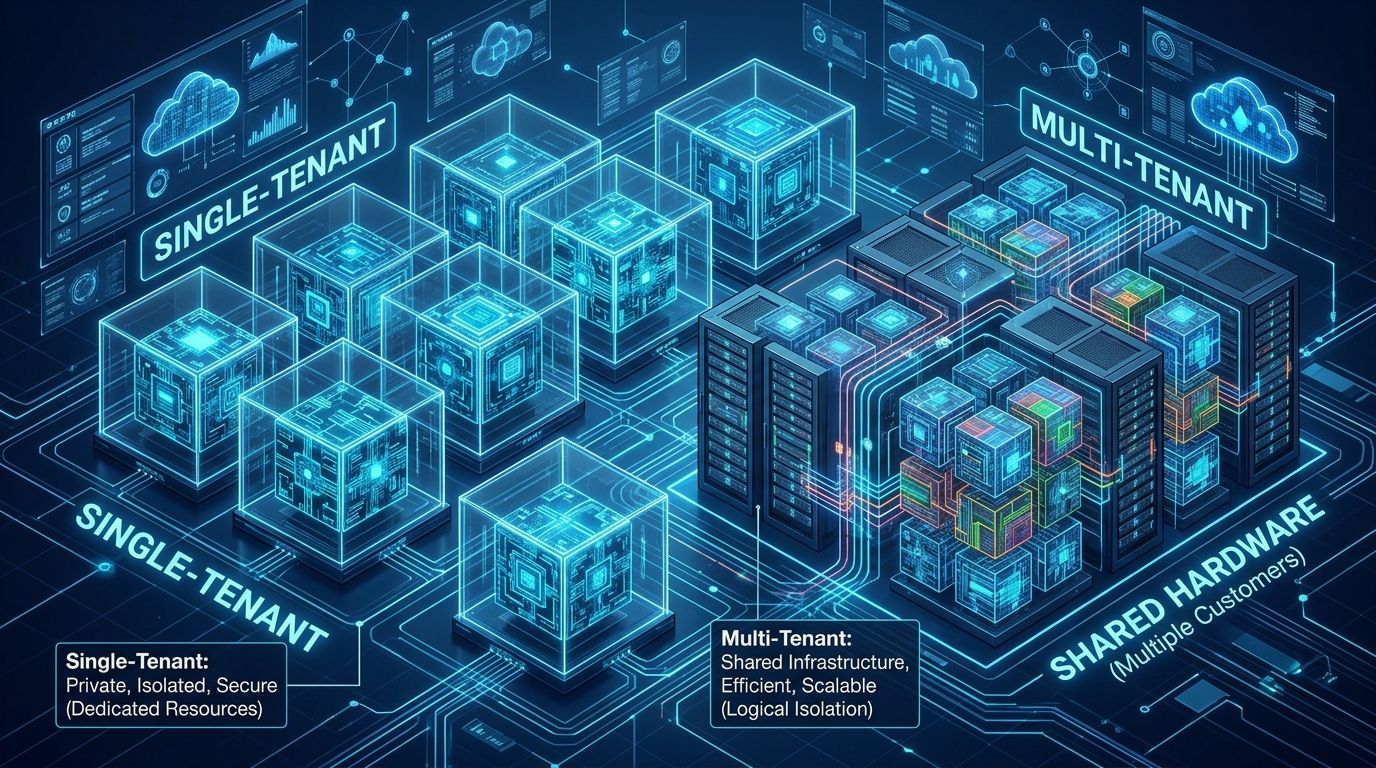
When you launch a Software-as-a-Service (SaaS) product, customer #1 signs up. A few days later, customer #2 joins. Six months later, customer #100 is onboarding. From the outside, every customer interacts with the same sleek web interface and accesses the same features. But behind the scenes, you face a foundational architectural question that will dictate your infrastructure costs, release cadence, and security posture for years to come: What exactly are your customers sharing, and where must the system draw impenetrable boundaries?
Are your customers sharing the web frontend? The API gateway? The application servers? The database engine? The physical storage volumes? And most critically of all: what must they never share under any circumstances? The answer to that last question is absolute: their protected customer data.
This dilemma sits at the heart of the architectural debate between Multi-Tenant and Single-Tenant systems. Yet too many discussions reduce this profound architectural decision to an oversimplified cliché: "Multi-tenant is cheaper; single-tenant is more secure." That framing is not only technically inaccurate—it blinds founders, CTOs, and software architects to the nuanced spectrum of tenancy patterns available in modern cloud environments.
1. Defining the Core Primitive: User ≠ Tenant
Before evaluating architectural trade-offs, we must establish a precise definition of the primary entity in any B2B SaaS system: the Tenant.
A tenant is an organizational boundary. Depending on your business domain, a tenant might represent a corporation, a venture-backed startup, a school, a university faculty, a medical clinic, a digital marketing agency, or an enterprise department.
The most pervasive data modeling mistake made by junior SaaS teams is conflating a User with a Tenant. In any serious SaaS application:
User is an authenticated human identity with verifiable credentials. A Tenant is an isolated organizational workspace with its own data, billing contracts, subscription tier, and security policies. A user accesses tenant data strictly through an explicit Membership association.
Consider a practical real-world scenario: an engineering consultant named Alex with the email identity alex@example.com. On Monday morning, Alex logs into your SaaS platform. Under Company A (an enterprise consulting client), Alex is an Administrator with billing management and user provisioning permissions. In the afternoon, Alex switches workspaces to Company B (a partner startup), where Alex is merely a read-only Viewer.
If your database schema relies on a flat column like users.role = "admin", your entire authorization model collapses the moment a single user participates in more than one organization. Authorization cannot be evaluated globally; it must always be evaluated within the context of an active, verified tenant boundary.
Tenant-Scoped Membership & Authorization Flow
How modern SaaS platforms evaluate permissions within an isolated workspace context
2. What is Multi-Tenant SaaS?
In a Multi-Tenant architecture, multiple customer organizations share the same underlying application infrastructure while maintaining strict logical isolation between their respective datasets, operational configurations, and computational workloads.
It is crucial to understand that multi-tenancy is an architectural design pattern spanning multiple layers of the technology stack—not a single monolithic implementation. A system can be multi-tenant at the web and compute tier while maintaining completely isolated databases per customer. Conversely, a system can share compute and database engines while maintaining strict logical data segregation via database policies.
3. What is Single-Tenant SaaS?
In a Single-Tenant architecture, each customer receives a dedicated, logically or physically isolated application environment. The customer's application compute, database, caching layer, and file storage are provisioned exclusively for their organization's usage.
A common misconception is that single-tenant SaaS implies shipping physical server hardware to a customer's basement or running on bare metal. In modern cloud architecture, single-tenant SaaS is virtually always provisioned on public cloud providers (AWS, Microsoft Azure, Google Cloud) using virtualized infrastructure, dedicated Kubernetes namespaces or clusters, isolated virtual private clouds (VPCs), and automated Infrastructure-as-Code (Terraform, Pulumi).
Multi-Tenant Architecture
Shared PoolMultiple customer organizations serve from a unified infrastructure layer with systematic logical enforcement.
Single-Tenant Architecture
Dedicated SiloEach customer operates within an isolated, dedicated deployment boundary with dedicated resources.
4. The Multi-Tenancy Spectrum: Four Data Isolation Models
Tenancy is a continuous architectural spectrum, particularly at the data persistence tier. When architecting a modern SaaS database, there are four primary models balancing cost, isolation, and operational overhead:
Shared Database + Shared Schema
All customer records live in identical tables segregated by a tenant_id discriminator column.
Shared Database + Separate Schemas
One database cluster houses distinct schema namespaces per customer (e.g., PostgreSQL schemas).
Database per Tenant
Application code connects dynamically to dedicated database instances or distinct catalog instances per customer.
Dedicated Deployment (Single-Tenant)
Complete, standalone infrastructure stack deployed per customer, including compute, cache, storage, and database.
Model A (Shared Database + Shared Schema): Every tenant-owned row includes a tenant_id. It provides unmatched cost efficiency, instant onboarding, and single-pass migrations. However, relying purely on application-level WHERE tenant_id = ? filters is risky. Production systems enforce defense-in-depth using PostgreSQL Row-Level Security (RLS) or ORM query interceptors.
Model B (Shared Database + Separate Schemas): Separate schema namespaces (tenant_a.orders, tenant_b.orders) provide cleaner logical boundaries. But as you scale past 3,000 tenants, database catalog tables (such as PostgreSQL's pg_class) swell, and schema migrations require executing loops across thousands of namespaces.
Model C (Database per Tenant): Each customer receives an isolated database catalog. Physical data boundaries prevent cross-tenant queries, and restoring a single tenant is trivial. However, connection pooling overhead (PgBouncer limits) and orchestrating migrations across thousands of databases introduce substantial operational friction.
Model D (Dedicated Deployment): Complete virtual stack isolation per customer. Eliminates noisy neighbors and accommodates custom compliance rules, but drastically multiplies cloud bills and operational labor due to configuration drift.
5. Tenant Isolation: A Systematic Engineering Discipline
The core rule of SaaS architecture is simple: Tenant A must never access Tenant B's protected data.
Isolation must be enforced systematically across every tier of the stack:
- Request Ingress: The API gateway validates cryptographic session claims, attaching an immutable tenant context object to each request.
- Database Layer: Enforcing PostgreSQL Row-Level Security (RLS) via session settings (
SET LOCAL app.current_tenant_id = :id) to reject cross-tenant queries at the database engine level. - Object Storage: Namespacing cloud storage paths (
s3://app/tenants/{tenant_id}/files/{uuid}) and generating short-lived pre-signed URLs strictly after authorization checks. - Asynchronous Queues: Serializing verified tenant identifiers directly into job payloads so worker threads operate within the correct tenant boundary.
- Distributed Caching: Namespacing every cache key to prevent cross-tenant cache leaks.
The Classic Multi-Tenant Cache Leak
Consider a common mistake where an engineer caches dashboard statistics using an unscoped key:
const cacheKey = "dashboard:stats";
const cached = await redis.get(cacheKey);
// ✅ SECURE: Key strictly namespaced by verified tenant context
const cacheKey = "tenant:" + ctx.tenantId + ":dashboard:stats";
const cached = await redis.get(cacheKey);
6. Tenant Context Determination: Routing Strategies
Applications determine tenant context using three primary routing patterns:
- Subdomains (e.g.,
acme.platform.com): Clean B2B branding, simplified browser cookie isolation, and tenant-specific login portals. Requires automated DNS management and wildcard SSL certificates. - Path-Based Routing (e.g.,
platform.com/orgs/acme): Unified domain simplifies SSL and local development, but exposes identifiers in URLs and complicates cookie scoping. - Session Claims & Switcher: Unified application URL where authenticated JWTs carry an active
tenant_idclaim, allowing users to switch workspaces smoothly.
X-Tenant-ID), a URL parameter, or a JSON payload—must NEVER be trusted without cryptographically verifying that the authenticated user possesses an active, valid membership in that specific tenant.
7. Data Modeling: Uniqueness & Constraints
Retrofitting multi-tenancy onto an existing single-tenant schema causes severe architectural bugs. In single-tenant systems, entity slugs are typically globally unique:
CREATE TABLE courses ( id UUID PRIMARY KEY, slug VARCHAR(255) UNIQUE, title TEXT );
-- Multi-tenant schema with composite uniqueness
CREATE TABLE courses (
id UUID PRIMARY KEY,
tenant_id UUID NOT NULL REFERENCES tenants(id) ON DELETE CASCADE,
slug VARCHAR(255) NOT NULL,
CONSTRAINT uq_tenant_course_slug UNIQUE (tenant_id, slug)
);
Enforcing UNIQUE(tenant_id, slug) ensures multiple organizations can publish courses with identical slugs (e.g., cybersecurity-101) without collision.
8. Database Indexing & Query Plans
In shared databases, queries filter by tenant: WHERE tenant_id = ? AND status = ? ORDER BY due_date ASC.
Without proper indexing, the database engine must scan massive volumes of rows belonging to other tenants. Multi-tenant tables require composite B-tree indexes where tenant_id is the leading column:
ON invoices (tenant_id, status, due_date);
Architects must inspect query plans with EXPLAIN ANALYZE, avoid index bloat, and evaluate declarative table partitioning (partitioning by tenant_id hash or list) for hyper-scale enterprise tables.
9. The "Noisy Neighbor" Problem & Performance Isolation
Logical data isolation guarantees Tenant A cannot view Tenant B's records. But it does not guarantee Tenant A cannot degrade Tenant B's performance.
If Tenant A triggers an unindexed 2-million record report at 9:00 AM, CPU saturation and connection starvation can take down interactive logins for Tenant B. Protecting multi-tenant systems requires active resource governance:
- Per-Tenant Rate Limiting: Enforcing Token Bucket algorithms via Redis to cap API burst rates based on subscription tier.
- SQL Statement Timeouts: Terminating queries that run longer than 5 seconds on interactive connection pools.
- Queue Segregation: High-priority interactive jobs (password resets, notifications) run on dedicated workers; heavy ETL and CSV imports run on background workers with strict concurrency limits.
- Usage Quotas: Hard caps on monthly storage ingestion and simultaneous background job executions.
10. Failure Blast Radius
In a pure multi-tenant system, the failure blast radius is broad: an unhandled memory leak or database outage affects all customers simultaneously. In single-tenant systems, the blast radius is localized to that specific customer's instance.
However, single-tenancy is not completely immune to wide-scale outages. Single-tenant instances still depend on shared cloud routing, centralized DNS, and global identity providers (Auth0, Cognito). If the continuous deployment pipeline ships a bad container build, all single-tenant environments fail together.
11. Deployments, Upgrades & Configuration Drift
Multi-tenant architectures enable rapid continuous delivery: deploy your application image to the shared cluster once, and all customers receive new features and security patches immediately.
In contrast, managing 200 single-tenant environments requires complex rolling update orchestration. Enterprise customers often reject upgrades during peak business cycles, forcing engineering teams to support dozens of legacy versions simultaneously. Over time, manual hotfixes create configuration drift, turning customer environments into fragile snowflakes that deviate from Infrastructure-as-Code definitions.
12. Database Migrations at Scale
Executing database schema changes in production reveals the operational reality of tenancy models:
Shared Database: A single migration updates all tenants atomically. Zero-downtime deployments demand non-breaking Expand and Contract patterns (adding nullable columns, dual-writing, backfilling asynchronously, and cleaning up old columns in subsequent releases).
Database-per-Tenant: Upgrading 1,000 customers requires running 1,000 distinct database migrations. Deployment pipelines must manage retries, handle transient network failures, and report schema drift.
13. Backups, Restores & Point-in-Time Recovery
While taking backups of a single shared database is straightforward, restoring a single customer is challenging:
In database-per-tenant and single-tenant architectures, tenant-specific restoration is trivial: you simply restore that customer's dedicated database snapshot or invoke point-in-time recovery without touching any other customer.
14. Customization Without Codebase Poisoning
In enterprise B2B SaaS, large customers will inevitably demand bespoke workflows. In poorly architected systems, developers insert hardcoded conditions:
if (tenant.slug === "megacorp") {
return executeBespokeBilling();
}
This anti-pattern quickly leads to technical debt. Scalable platforms handle customization through configuration-driven architecture:
- Feature Flags: Dynamically toggling modules per tenant tier.
- Declarative Rule Engines: Storing customer-specific business logic as JSON rules evaluated at runtime.
- Webhooks & Event Streams: Emitting standardized events (e.g.,
invoice.paid) allowing enterprise clients to trigger external AWS Lambda functions or integrations.
15. The Economics of Tenancy: True Cost Drivers
Cloud compute costs are only one component of the total cost of ownership (TCO):
| Cost Dimension | Multi-Tenant (Shared) | Single-Tenant (Dedicated) |
|---|---|---|
| Compute Utilization | High bin-packing density. Idle resources amortized across active users. | Low density. Customers pay for dedicated idle compute 24/7. |
| Database Licensing | Unified cluster licensing. Minimal baseline overhead. | Multiplied license and instance fees per customer stack. |
| Initial Engineering | High upfront investment in RLS, middleware, and isolation testing. | Simpler initial code; lower upfront data modeling complexity. |
| DevOps Labor | Low. Single deployment pipeline, unified monitoring, centralized logs. | Very High. Automating provisioning, monitoring, and upgrading hundreds of stacks. |
| Support & Triage | Fast bug reproduction on a single unified production state. | Slower triage due to environment drift and version lag. |
16. The Security Reality: Demystifying Common Myths
The belief that single-tenant systems are automatically secure while multi-tenant systems are insecure is incorrect.
A single-tenant environment deployed with unpatched OS CVEs, wide-open security groups (0.0.0.0/0), and weak IAM credentials is deeply vulnerable. Physical isolation does not compensate for application-level security flaws.
Conversely, financial payment platforms (Stripe) and hyperscalers (AWS, GCP) operate multi-tenant architectures serving the world's most regulated organizations. They achieve bank-grade security through systematic defense-in-depth, cryptographic tenant segregation, formal regression testing, and comprehensive audit trails.
17. The Hybrid Tenancy Model
Modern SaaS architecture does not require choosing between 100% pure multi-tenancy and 100% single-tenant silos. The industry standard pattern is Hybrid Tenancy:
This approach enables high-margin growth for standard self-serve users while unlocking high-value contracts with healthcare, banking, and government entities that mandate dedicated infrastructure.
18. The 10-Row Comprehensive Decision Matrix
Compare the three architectures across key technical and operational dimensions:
| Architectural Dimension | Multi-Tenant (Shared) | Single-Tenant (Isolated) | Hybrid Architecture |
|---|---|---|---|
| 1. Infrastructure Efficiency | Highest. Maximizes compute and database bin-packing density. | Lowest. High idle cost multiplied per customer environment. | Balanced. High density for standard tiers; enterprise margins absorb costs. |
| 2. Data Isolation Boundary | Logical enforcement via RLS, query middleware, and scoped cache keys. | Physical / instance isolation at the compute and storage tier. | Logical by default; physical isolation provisioned on-demand. |
| 3. Deployment Simplicity | Fast, single-pipeline continuous delivery for all customers. | Complex multi-environment rollout orchestration. | Single control plane rollout; orchestrated rolling updates for dedicated silos. |
| 4. Per-Tenant Customization | Strictly configuration-driven (feature flags, theme tokens, webhooks). | High flexibility, but creates severe maintenance and drift risks. | Configuration-driven for shared tier; custom integrations for enterprise tier. |
| 5. Operational Complexity | Low ongoing operational overhead; high initial engineering rigor. | Very high operational labor for monitoring and patching. | Moderate; requires robust automation tooling for dedicated provisioning. |
| 6. Tenant-Specific Restoration | Complex. Requires staging restore and surgical row extraction. | Trivial. Snapshot restore isolated to a single customer. | Complex for shared tier; trivial for dedicated enterprise tier. |
| 7. Scaling Strategy | Horizontal compute autoscaling; database read replicas and table partitioning. | Vertical and horizontal scaling tuned per customer instance. | Shared cluster scales elastically; enterprise clusters scale independently. |
| 8. Noisy Neighbor Blast Radius | Requires active rate limiting, timeouts, and queue segregation. | Zero noisy neighbor impact across customer organizations. | Standard tier protected by rate limits; enterprise tier completely insulated. |
| 9. Schema Migration Execution | Single atomic migration requiring expand-and-contract zero-downtime discipline. | Orchestrating hundreds of migrations with distributed retry handling. | Unified migration on shared DB; automated sequential migration on dedicated DBs. |
| 10. Enterprise Compliance Flexibility | Satisfies SOC 2 and ISO 27001; may meet resistance for air-gapped / BYOK demands. | Easily satisfies customer-managed keys (BYOK) and dedicated residency. | Maximum flexibility. Closes enterprise deals without re-architecting the core product. |
19. The SaaS Architecture Decision Tree
Follow this systematic decision flowchart to identify the optimal path for your platform:
The SaaS Architecture Decision Hierarchy
Follow the primary decision branches based on your market requirements, regulatory climate, and engineering capabilities.
Ideal for high-velocity self-serve, SMB, and mid-market SaaS platforms seeking maximum margins and rapid continuous delivery.
Delivers shared multi-tenant efficiency for standard users, with automated dedicated database provisioning for enterprise tiers.
20. Real-World Case Study: Multi-Tenant Learning Management Platforms
To see these architectural principles in action, consider a modern multi-tenant Learning Management System (LMS).
Imagine an educational platform serving three distinct organizations:
- Tenant A (Corporate Enterprise): Delivers internal compliance training to 5,000 employees.
- Tenant B (University Faculty): Manages accredited degree courses for 1,200 undergraduate students.
- Tenant C (Commercial Training Provider): Sells coding bootcamps to public self-serve applicants.
All three organizations share the same core learning engine: video streaming pipelines, quiz evaluation services, and certificate generators. Yet their data boundaries must be airtight: under no circumstances may Tenant A's proprietary corporate videos appear in Tenant B's catalog, nor may instructors from Tenant C access grade submissions from Tenant A.
Furthermore, user roles must be evaluated dynamically within the active tenant context: a professor who is an Administrator in Tenant B might enroll as a Student in a specialized evening workshop hosted by Tenant C.
This exact architectural challenge was central to the engineering of Kamashka Academy (kamshka.com/academy). Built as a specialized multi-tenant educational platform currently operating in private pilot phases, Kamashka Academy was designed from day one around strict tenant-scoped RBAC and database isolation. By decoupling universal user identity from organization-specific memberships and establishing tenant-aware caching and routing boundaries, the platform provides institutional isolation without duplicating application infrastructure.
21. Architectural Conclusion: Aligning Tenancy with Business Strategy
Tenancy is not merely a database decision. It is an overarching business, engineering, and operational commitment.
If your target audience is self-serve users, small businesses, or mid-market companies where speed of iteration, automated onboarding, and high gross margins are paramount, a well-engineered Multi-Tenant architecture is almost always the correct foundation. The key is implementing systematic defense-in-depth from day one—leveraging database Row-Level Security, tenant-scoped caching, composite indexing, and rate limiting to prevent data leaks and noisy neighbors.
If you operate in highly regulated enterprise sectors where customer contracts legally mandate customer-managed encryption keys, dedicated database clusters, or strict physical data residency, adopting a Hybrid Tenancy model gives you the flexibility to capture high-value enterprise revenue without forfeiting the operational efficiency of shared cloud infrastructure.
Whatever path you choose, make the decision deliberately. The most costly mistake in software architecture is stumbling into a tenancy model by accident.
Planning to Build or Scale a Modern SaaS Platform?
Designing production SaaS demands deliberate alignment between customer requirements, tenant isolation boundaries, RBAC systems, and operational economics. Kamashka engineers scalable, resilient multi-tenant and hybrid cloud software architectures.
The Complete SaaS Architecture & Engineering Series
A 6-part deep architectural series covering tenancy models, access control, data isolation, and cloud scaling.
A comprehensive architectural evaluation of isolation boundaries, operational trade-offs, and cloud economics.
A production guide to tenant-scoped authorization, fine-grained permission models, and defensive testing.
A strategic decision guide evaluating workflow uniqueness, TCO, integration overhead, and build-vs-buy tradeoffs.
Architectural analysis of cloud cost inflection points, database bottlenecks, and early efficiency design.
In-depth implementation guide to Row-Level Security, tenant-scoped storage, cache safety, RAG retrieval boundaries, and background workers.
An architectural guide to operational readiness: safe migrations, tested restores, idempotency, observability, and failure recovery.