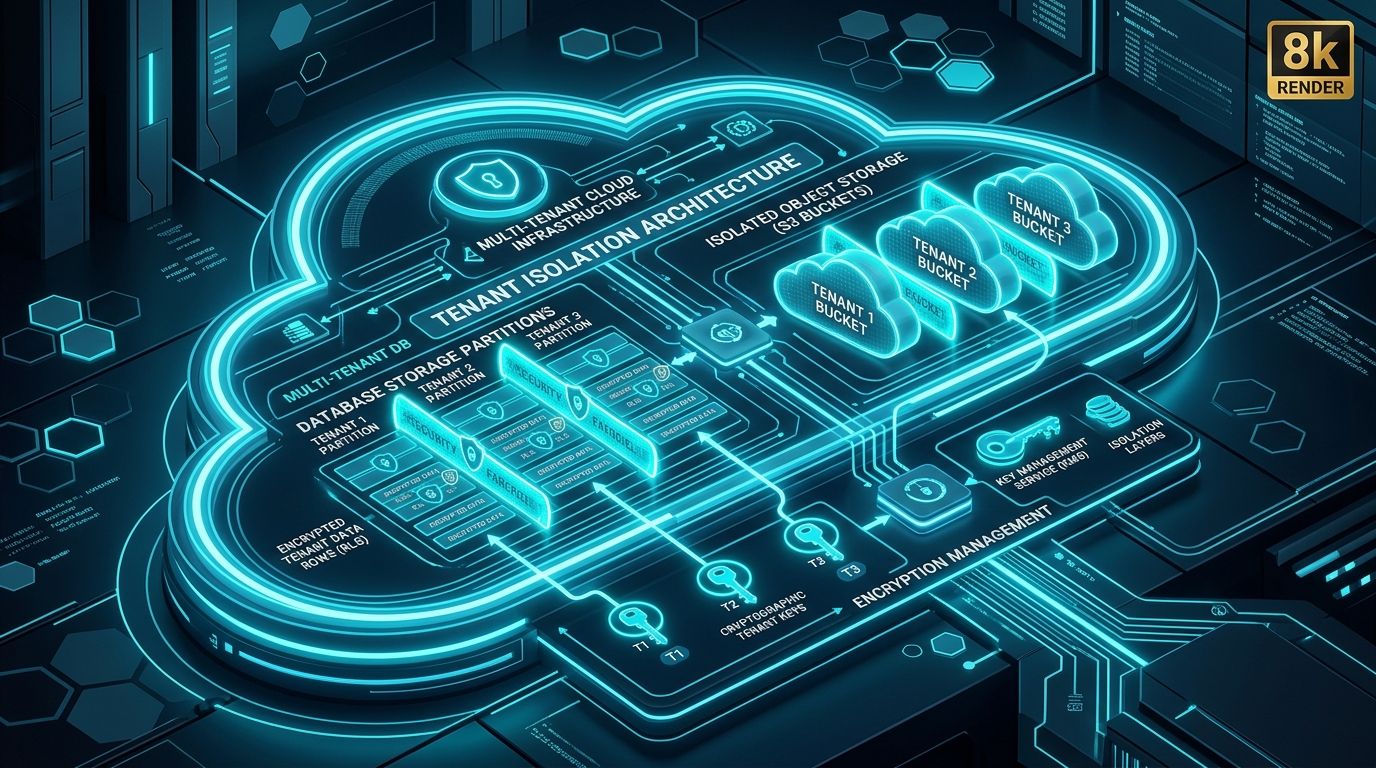
In modern software engineering, security vulnerabilities rarely announce themselves with dramatic system crashes or smoking servers. Instead, the most catastrophic data leaks in cloud software often look like perfectly routine, successful operations. Consider this seemingly harmless database query:
SELECT * FROM projects WHERE id = :project_id;To an untrained eye, this is textbook data fetching. The query is parameterized, eliminating SQL injection. It filters by primary key, executing in under a millisecond. In local testing, it runs flawlessly. But imagine this scenario in a production multi-tenant SaaS application: Project 123 belongs to Company B, while the currently authenticated user belongs to Company A. If the application controller merely checks whether Project 123 exists—rather than verifying whether Project 123 belongs to the tenant this user is authorized to access—the database returns confidential commercial records to a competitor.
No error was thrown. No server crashed. The HTTP status code was 200 OK. The database did exactly what it was told. But the foundational security contract of multi-tenant computing was shattered.
The defining imperative of any multi-tenant platform is simple to state: Tenant A must never access, view, modify, or infer Tenant B's private data. The immense engineering challenge is ensuring that this statement remains true not just in database queries, but across APIs, authentication tokens, object storage, caching tiers, search indexes, realtime WebSocket streams, background workers, export jobs, and modern AI/RAG retrieval pipelines.
Tenant data isolation is not a WHERE clause. Tenant data isolation is an end-to-end system property.
The Multi-Tenant Access Authorization Lifecycle
Every protected operation must validate six sequential trust boundaries before data is accessed.
The Multi-Tenancy Foundation: Reconnecting to Architecture & RBAC
In our earlier architectural exploration, Multi-Tenant vs Single-Tenant SaaS: Which Architecture Should You Choose?, we examined the physical infrastructure spectrum: from isolated database-per-tenant deployments to pooled shared-database, shared-schema architectures. In Building Role-Based Access Control for Modern SaaS Platforms, we established the authorization mechanics of roles, scopes, and tenant-level memberships.
It is vital to recognize where Role-Based Access Control ends and tenant isolation begins:
- RBAC answers capability questions: "Does this user have permission to delete projects?"
- Tenant isolation answers boundary questions: "Does this project belong to the specific tenant organization this user is authorized to manage right now?"
A user can possess the highest administrative role in Tenant A, but when interacting with the system, they must have zero authority over resources owned by Tenant B. Regardless of whether your platform utilizes separate PostgreSQL schemas, shared tables with discriminant columns, or pooled document stores, your application requires a systematic mechanism to enforce isolation across every ingress and egress path.
Tenant Context Must Come from a Trusted Path
The most elementary failure in multi-tenant engineering is treating client-supplied tenant identifiers as authoritative permissions. Consider an HTTP request:
GET /api/v1/invoices/9482?tenantId=company-b HTTP/1.1
Host: api.saasplatform.com
Authorization: Bearer eyJhbGciOi... (Token for User from Company A)
The presence of tenantId=company-b in a query parameter, request body, or custom HTTP header (X-Tenant-ID) merely expresses a request intention. It does not prove that the authenticated user has any legitimate affiliation with Company B.
Trustworthy architecture resolves tenant context exclusively through authenticated server-side resolution:
- Cryptographically Signed Tokens: The tenant context is encoded inside a signed, tamper-proof session JWT (e.g.,
org_id: "org_abc123") minted by your authentication service. - Authorized Hostname / Subdomain Routing: When routing requests via customer vanity domains (e.g.,
acme.saasplatform.com), the API gateway maps the subdomain to an internal tenant ID and validates that the authenticated user possesses an active membership in that organization. - Server-Side Session Lookup: The user's active organization is stored in server-side session state and cannot be manipulated by client-side JavaScript.
The Golden Rule: Client input may identify the requested tenant; it must never, under any circumstances, authorize access to that tenant.
The End-to-End Tenant Isolation Boundary
Tenant boundaries must encompass every data store and execution path across the cloud stack.
- Mandatory discriminant
tenant_id - PostgreSQL Row-Level Security (RLS)
- Composite uniqueness constraints
- Strict foreign key tenant propagation
- Tenant-scoped path prefixes
- Time-bounded pre-signed URLs
- Application-level download gates
- Zero public bucket permissions
- Tenant-prefixed key namespaces
- Scoped serialization boundaries
- Invalidation on membership revocation
- Never caching global entities blindly
- Mandatory tenant filter on all queries
- Isolated tenant routing keys
- Autocomplete suggestion scoping
- Document-level security policies
- Metadata-filtered vector search
- Authorize before context reaches LLM
- Never relying on prompt instructions
- Tenant-isolated embedding namespaces
- Trusted tenant context in job payloads
- Tenant-isolated worker execution
- Scheduled jobs processed per-tenant
- Export file generation access gates
Database Layer: Shared Schema Architecture & The Myth of the WHERE Clause
In a shared-database, shared-schema multi-tenant architecture, records from multiple customers coexist within the same relational tables, separated by a discriminant column (traditionally tenant_id):
CREATE TABLE projects (
    id UUID PRIMARY KEY DEFAULT gen_random_uuid(),
    tenant_id UUID NOT NULL REFERENCES tenants(id) ON DELETE CASCADE,
    name VARCHAR(255) NOT NULL,
    status VARCHAR(50) NOT NULL,
    created_at TIMESTAMPTZ NOT NULL DEFAULT NOW()
);
In this model, every single read, update, and delete operation must strictly append WHERE tenant_id = :current_tenant_id. But relying exclusively on developers remembering to manually append this filter to every SQL statement or ORM query is an architectural catastrophe waiting to happen.
Humans get tired. Deadlines loom. Junior engineers join the team. New microservices bypass familiar repository abstractions. A single neglected filter on a DELETE or UPDATE endpoint can overwrite or expose millions of rows across foreign tenants.
1. Resource IDs Are Not Authorization
A frequent fallacy is believing that adopting unguessable identifiers (like UUIDv4) eliminates the need for strict tenant validation: "Nobody can guess a 128-bit random UUID, so we can just query by ID."
This is a critical misunderstanding of access control. UUIDs prevent casual enumeration attacks (iterating /projects/1, /projects/2), but they do not provide authorization. IDs leak through browser histories, employee screenshares, webhooks, API logs, and shared links. If User A pastes a UUID belonging to Company B into your application, the platform must reject the request with absolute certainty because knowing an identifier does not grant permission to the entity.
2. Direct vs. Indirect Tenant Ownership
Not every table in your database should blindly receive a tenant_id column. Architecture must distinguish between entity tiers:
- Global Entities: Standard country lists, currency codes, system permission definitions. These contain zero customer data and are accessible platform-wide.
- Directly Owned Tenant Entities: Core business containers such as
workspaces,invoices,customers, andprojects. These must possess explicittenant_idforeign keys. - Indirectly Owned Entities: Granular child records such as
project_task_commentsorinvoice_line_items.
With child records, engineers face an architectural trade-off: Do you normalize strictly (deriving tenant ownership by joining through comments → tasks → projects → tenants), or do you denormalize by placing tenant_id directly on the comment table?
While pure normalization satisfies database theory, denormalizing tenant_id onto high-frequency child tables allows queries, database indexes, and row-level policies to filter on tenant boundaries directly without expensive multi-table joins.
3. Composite Uniqueness Constraints
In single-tenant applications, unique constraints are global (e.g., UNIQUE(slug) or UNIQUE(employee_code)). In a multi-tenant platform, global uniqueness breaks multi-tenancy rules: Tenant A creating a workspace named "general" or "marketing" must never prevent Tenant B from using those identical names.
Data models must enforce composite uniqueness:
-- Enforces uniqueness strictly within the tenant boundary
ALTER TABLE projects ADD CONSTRAINT uq_tenant_slug UNIQUE (tenant_id, slug);
Similarly, composite foreign keys can prevent cross-tenant corruption: ensuring that an order belonging to Tenant A cannot accidentally reference a customer_id belonging to Tenant B.
PostgreSQL Row-Level Security (RLS): A Defense-in-Depth Tool
To avoid relying entirely on application developers remembering tenant filters, PostgreSQL provides Row-Level Security (RLS). When enabled, the database engine itself enforces access control policies on every table before returning rows to the executing connection.
In an RLS architecture, the application layer sets a session variable specifying the active tenant before executing queries:
-- 1. Enable RLS on the table
ALTER TABLE projects ENABLE ROW LEVEL SECURITY;

-- 2. Force RLS for all table owners (prevent accidental bypass)
ALTER TABLE projects FORCE ROW LEVEL SECURITY;

-- 3. Define the tenant isolation policy
CREATE POLICY tenant_isolation_policy ON projects
    FOR ALL
    USING (tenant_id = NULLIF(current_setting('app.current_tenant_id', true), '')::UUID);
When a request arrives, the application middleware extracts the trusted tenant context from the session and sets the local session configuration inside the database transaction:
BEGIN;
SET LOCAL app.current_tenant_id = 'c4b8e920-8e12-4c22-bcf8-92f741d248a1';
-- Any query executed here will ONLY see rows matching this tenant_id!
SELECT * FROM projects;
COMMIT;
The Realities and Hazards of RLS
While RLS is an exceptional defensive mechanism, RLS is not magic, and it is not a substitute for application-level architecture:
- Database Superuser Bypass: In PostgreSQL, database superusers and roles with the
BYPASSRLSattribute automatically ignore all row-level security policies. If your application connects to the database using thepostgressuperuser, RLS provides zero protection. The application must connect via an unprivileged application role. - The Connection Pool Poisoning Hazard: Modern web platforms utilize connection poolers (like PgBouncer or Supabase poolers). If your application executes
SET app.current_tenant_id = 'tenant_a'without usingSET LOCAL(or fails to executeDISCARD ALL/RESETwhen returning the connection to the pool), that pooled connection may retain Tenant A's context when assigned to a subsequent request from Tenant B! Transactions must strictly utilizeSET LOCALto guarantee that session state is destroyed immediately upon transaction commit or rollback. - Background Workers & Migrations: Automated migrations, database seeders, and cross-tenant reporting cron jobs fail if RLS session variables are not explicitly configured for administrative contexts.
The Tenant Context Survival Pipeline
How trusted tenant metadata must propagate end-to-end through distributed services without getting lost.
Authenticates JWT, validates organization membership, and injects verified tenant_context into request scope.
Accepts tenant_context parameter; enforces tenant scoping on all SQL queries and ORM operations.
Serializes tenant_id and user_id into background job payload; rejects unauthenticated job dispatches.
Initializes trusted tenant context from message envelope before executing async processing logic.
Generates isolated object path (tenants/{tenant_id}/exports/...) with private access policies.
Delivers download notification exclusively to the originating tenant's authorized user channel.
Beyond SQL: Isolating the Rest of the Cloud Stack
The most sophisticated database policies in the world cannot protect a SaaS application if the rest of the cloud infrastructure treats customer data as a global pool. Multi-tenancy must be enforced across every storage and communication layer.
1. Object Storage: Path Structure Is Not Authorization
In cloud object storage (Amazon S3, Google Cloud Storage, Cloudflare R2), organizing customer assets into folders seems clean:
s3://saas-production-assets/tenants/org_101/contracts/annual_agreement.pdf
s3://saas-production-assets/tenants/org_202/contracts/confidential_merger.pdf
However, folder naming is merely an organizational hierarchy—it is not an access control system. If your object storage bucket is publicly readable, or if your application serves raw asset URLs directly to client browsers, any user who discovers or guesses a file URL can download another customer's private documents.
Secure object storage requires three architectural invariants:
- Buckets Must Be 100% Private: Public read access must be permanently disabled at the cloud provider level.
- Short-Lived Pre-Signed URLs: When a user requests a file, the application validates their tenant membership and permissions first. Only then does it generate a time-limited (e.g., 60 seconds), cryptographically signed URL allowing direct download from storage.
- Randomized Filenames Are Not Security: Obscuring a sensitive document behind a random hash (
/uploads/a8f9c1b2-contracts.pdf) does not constitute security. If an authorization gate is absent, obscurity is meaningless.
2. The In-Memory Cache Is Part of Your Security Boundary
In high-throughput SaaS platforms, caching (Redis, Memcached) is essential for performance, as detailed in our guide on SaaS Scaling Costs. But caches frequently introduce cross-tenant leakage through sloppy key naming:
// CATASTROPHIC BUG: Global cache key leaks data across tenants!
const cachedMetrics = await redis.get('dashboard:metrics:summary');
if (cachedMetrics) return cachedMetrics;

// CORRECT: Cache key strictly incorporates tenant isolation boundary
const cacheKey = `tenant:${tenantContext.id}:dashboard:metrics:summary`;
const cachedMetrics = await redis.get(cacheKey);
If Tenant A visits their dashboard and the application caches their financial summary under a generic key, Tenant B visiting moments later will be served Tenant A's private numbers directly out of RAM.
Furthermore, cache invalidation must align with authorization changes. If an employee is terminated from an organization, or if a tenant's subscription is suspended, their cached authorization tokens and tenant-scoped session payloads must be purged immediately—not hours later when a TTL expires.
3. Search Engines & The Autocomplete Leak
When platforms integrate full-text search engines (Elasticsearch, OpenSearch, Meilisearch), developers often synchronize database records into a single global index.
If a search query fails to inject a strict mandatory filter on tenant_id:
{
  "query": {
    "bool": {
      "must": { "match": { "content": "financial audit" } },
      "filter": { "term": { "tenant_id": "current-tenant-uuid" } }
    }
  }
}
The search engine will index and match terms across every customer on the platform. Even subtle features like search autocomplete suggestions can leak confidential competitor names, project titles, and employee emails if suggestion aggregations are calculated globally rather than scoped to the active tenant.
Multi-Tenant AI / RAG Retrieval Architecture
Why authorization must occur before retrieved document context ever reaches the LLM.
tenant_id: "org_alpha".{ tenant_id: { $eq: "org_alpha" } } before semantic similarity search.The Multi-Tenant AI Hazard: RAG and Vector Databases
The explosion of generative AI features in SaaS platforms has introduced one of the most dangerous cross-tenant leakage vectors in modern software history: Retrieval-Augmented Generation (RAG).
SaaS products frequently allow customers to "Chat with your internal knowledge base" or "Search company contracts with AI." The architecture behind this feature embeds customer documents into high-dimensional vectors stored inside a vector database (Pinecone, Qdrant, Milvus, pgvector).
If an engineer performs a naive cosine-similarity vector search:
// DANGEROUS ANTI-PATTERN: Vector search with zero tenant isolation
const similarChunks = await vectorStore.query({
  vector: promptEmbedding,
  topK: 5,
  // MISSING: Tenant filter!
});
The vector database will dutifully return the five most semantically relevant text chunks across the entire global index. If Tenant B's confidential pricing spreadsheet happens to contain keywords highly similar to Tenant A's question, Tenant B's proprietary data is pulled into the prompt and fed directly to the model. The LLM will then faithfully summarize Tenant B's confidential terms for Tenant A.
The AI did not fail; the retrieval layer failed.
Vector embeddings are sensitive data representations. You must enforce hard pre-filtering on all vector queries:
// SECURE PATTERN: Enforce tenant pre-filtering on vector queries
const similarChunks = await vectorStore.query({
  vector: promptEmbedding,
  topK: 5,
  filter: {
    tenant_id: { $eq: tenantContext.id },
    visibility: { $in: userRoles.permittedScopes },
  },
});
Under no circumstances should you rely on LLM system prompt instructions like "Please do not mention Company B's information." LLMs are probabilistic text processors susceptible to prompt injection, jailbreaks, and hallucinations. They are not security filters. Authorize before context reaches the model.
Cross-Tenant Security Validation Matrix
Defensive automated test coverage mapping user roles against cross-tenant resource access.
| Authenticated Subject | Tenant A Entity | Tenant B Entity | Expected Response |
|---|---|---|---|
| Tenant A Member | ALLOW | DENY (404/403) | Strictly limited to own organization boundary |
| Tenant A Workspace Owner | ALLOW | DENY (404/403) | Highest tenant role has zero foreign authority |
| Tenant B Member | DENY (404/403) | ALLOW | Symmetric isolation boundary enforced |
| Platform Support Specialist | TIME-BOUNDED | TIME-BOUNDED | Explicit audited grant required; read-only default |
| Anonymous / Unauthenticated | DENY (401) | DENY (401) | Authentication required prior to tenant routing |
Defensive Testing: Why Negative Tests Are Everything
Most engineering teams write automated tests that verify successful user journeys:
// Standard Happy-Path Test
it('should allow Tenant A admin to fetch their project', async () => {
  const res = await api.get('/projects/123', { auth: userA });
  expect(res.status).toBe(200);
});
In multi-tenant software, happy-path tests only prove that features work under ideal conditions. To ensure data isolation, negative cross-tenant tests are vastly more important:
// Mandatory Negative Cross-Tenant Security Test
it('should strictly prevent Tenant B user from accessing Tenant A project', async () => {
  const res = await api.get(`/projects/${projectA.id}`, { auth: userB });

  // Must return 404 Not Found (or 403 Forbidden without entity confirmation)
  expect(res.status).toBe(404);
  expect(res.body.project).toBeUndefined();
});
Every automated test suite for a SaaS platform should implement helper assertions (such as assertTenantCannotAccess(foreignUser, targetResource)) and systematically test every protected route across the Tenant Matrix. A feature should not be considered production-ready until its negative cross-tenant authorization tests pass in CI/CD.
The 18-Point Production Tenant Isolation Checklist
A rigorous architectural gate before shipping multi-tenant features to live enterprise environments.
Is every entity explicitly designated as Global, Tenant-Owned, or User-Owned?
Does tenant context resolve strictly from cryptographically signed tokens or verified sessions?
Does middleware verify that the user's account has not been revoked within the active tenant?
Does every query verify both resource_id AND tenant_id?
Are RLS policies enabled and verified on all tenant-owned relational tables?
Are session variables scoped via SET LOCAL to prevent connection pool poisoning?
Do all Redis and in-memory cache keys include the active tenant_id prefix?
Are object storage files 100% private and accessed exclusively via short-lived signed URLs?
Do search and autocomplete queries enforce mandatory tenant-level boolean filters?
Are vector database embeddings filtered by tenant ID before passing context to LLMs?
Are WebSocket subscription channels authorized server-side before establishing listeners?
Do background worker job payloads carry authenticated tenant metadata end-to-end?
Are generated CSV/PDF exports stored in private namespaces with automated retention cleanup?
Are full request payloads and secrets redacted before logging to centralized log systems?
Do error responses return 404 Not Found rather than confirming existence of foreign resources?
Are platform admin and support staff actions explicitly logged to immutable audit trails?
Does deleting a tenant purge related storage, vector embeddings, cache, and search docs?
Are cross-tenant unauthorized access attempts verified as blocked in automated CI suites?
The "New Data Store" Rule
Every time your platform adopts a new data store—whether adding Redis for caching, OpenSearch for querying, or Pinecone for AI vectors—you must re-ask the tenant isolation question from scratch. A database is not the only place customer data lives.
The "New Execution Path" Rule
Every time your application adds a new asynchronous execution path—such as background queue workers, cron schedulers, webhook listeners, or AI agent pipelines—you must ensure trusted tenant context propagates completely through the execution loop.
Real-World Context: Multi-Tenancy in Kamashka Academy
A multi-tenant educational platform provides a clear, relatable illustration of these principles in practice. Within a learning management system like Kamashka Academy, multiple distinct organizations and technical academies operate on a single underlying cloud infrastructure.
If Academy Alpha and Academy Beta share the same platform, the architecture must guarantee that Academy Alpha cannot view or modify Academy Beta's:
- Enrolled students and applicant profiles
- Proprietary course curricula and assignment submissions
- Grading rubrics and student assessment records
- Uploaded project files and technical lecture notes
If an API query returns student grades without verifying the academy's tenant context, or if a global search bar allows students from one academy to discover lecture notes from another, the entire commercial integrity of the platform is compromised. Enforcing strict tenant boundaries across every query, cache key, and storage bucket ensures that multi-tenant economics deliver high scalability without sacrificing enterprise privacy.
Architecting Secure Enterprise SaaS Platforms with Kamashka
Multi-tenant software is not secure because every database table has a tenant_id column. It is secure only to the extent that tenant boundaries are consistently, defensively enforced across every single system that handles, stores, or processes customer data.
At Kamashka Technology, our engineering teams architect custom cloud platforms, multi-tenant SaaS engines, and enterprise business systems designed from the ground up for airtight data isolation, robust role-based access control, and long-term scaling efficiency.
If your organization is building a new multi-tenant SaaS platform or hardening an existing architecture to meet stringent enterprise compliance and security standards, explore our Software Development & Architecture Services or contact our senior engineering team to design a system where customer data remains unconditionally secure.
Planning to Build or Scale a Modern SaaS Platform?
Designing production SaaS demands deliberate alignment between customer requirements, tenant isolation boundaries, RBAC systems, and operational economics. Kamashka engineers scalable, resilient multi-tenant and hybrid cloud software architectures.
The Complete SaaS Architecture & Engineering Series
A 6-part deep architectural series covering tenancy models, access control, data isolation, and cloud scaling.
A comprehensive architectural evaluation of isolation boundaries, operational trade-offs, and cloud economics.
A production guide to tenant-scoped authorization, fine-grained permission models, and defensive testing.
A strategic decision guide evaluating workflow uniqueness, TCO, integration overhead, and build-vs-buy tradeoffs.
Architectural analysis of cloud cost inflection points, database bottlenecks, and early efficiency design.
In-depth implementation guide to Row-Level Security, tenant-scoped storage, cache safety, RAG retrieval boundaries, and background workers.
An architectural guide to operational readiness: safe migrations, tested restores, idempotency, observability, and failure recovery.