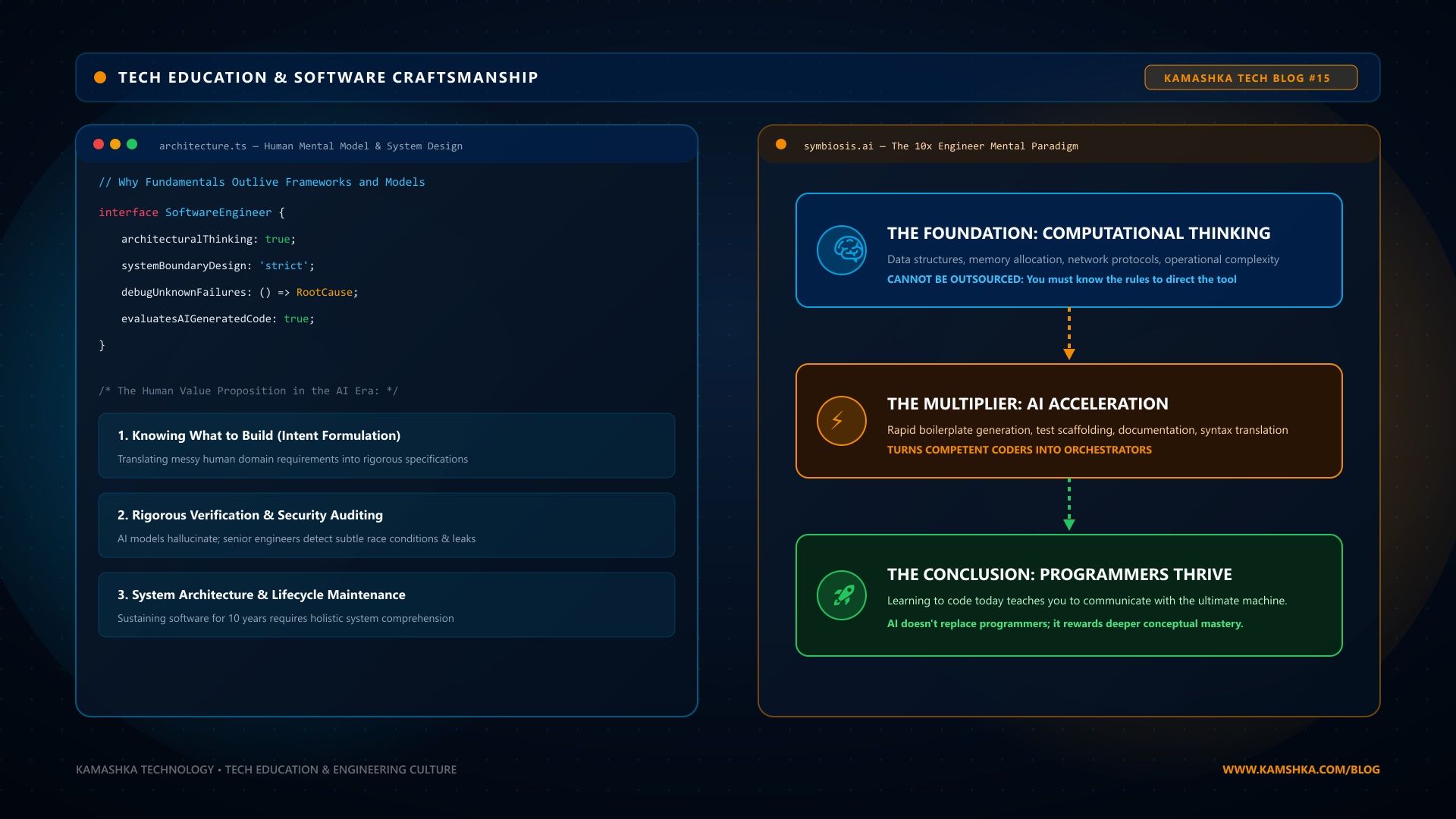
You open an AI coding assistant. You type: "Build me a responsive login page in React with Tailwind CSS." In three seconds, the code streams across your screen. You type: "Now create an Express backend with JWT authentication and connect it to a PostgreSQL database." Another five seconds, and complete backend endpoints, database connection pools, and migration scripts appear before your eyes. At that exact moment, every aspiring programmer, university student, and career switcher asks the exact same terrifying question: "Why am I spending months struggling to learn programming syntax, data structures, and debugging when artificial intelligence can already write all of this in seconds?"
The Core Shift: From Typing Code to Verifying Systems
The fear that AI makes learning to code obsolete stems from a fundamental misunderstanding of what software engineering actually is. For decades, popular culture and introductory tutorials conflated typing code with building software. Because writing code was historically the primary bottleneck, people assumed that memorizing syntax was the core skill of a developer.
AI has shattered that illusion. Generating code is no longer the bottleneck. Today, foundation models can effortlessly produce boilerplate, write standard database queries, scaffold frontend components, generate unit tests, and translate snippets between languages.
AI does not make learning to code pointless; it radically changes what "knowing how to code" needs to mean.
The economic and intellectual value of programming is shifting away from mechanical syntax transcription toward system comprehension, problem decomposition, architectural judgment, and rigorous verification. The defining question for a modern software developer is no longer simply: "Can you write this code?" It is: "Do you understand this code well enough to trust it in production?"
Code Is Just One Layer of Software Engineering
Writing code is merely the implementation mechanism of a much broader, multi-disciplinary engineering process. Consider the complete lifecycle of any real-world digital product:
The Full Spectrum of Software Engineering
What problem are we solving? What should happen? What must never happen?
How do client, server, cache, queue, and database interact under load?
Relational schemas, foreign keys, uniqueness invariants, and transaction boundaries.
Deterministic financial, regulatory, operational, and permission rules.
Syntactic transcription (The specific layer AI accelerates dramatically).
Unit, integration, edge cases, regression suites, and security scans.
CI/CD pipelines, containerization, environment variables, and networks.
Telemetry, error budgets, structured logging, latency metrics, and alerts.
Refactoring, dependency upgrades, schema migrations, and bug diagnosis.
The Calculator Analogy: Where It Works and Where It Fails
People frequently compare AI coding assistants to the electronic calculator. When handheld calculators became ubiquitous in the 1970s, pessimists predicted that learning mathematics would become useless. In reality, the calculator eliminated the tedium of long division by hand, allowing engineers and scientists to focus on higher-level mathematical modeling, calculus, physics, and statistics.
AI coding tools create a similar shift: they eliminate the friction of looking up obscure API syntax, writing repetitive HTML boilerplate, or manually constructing SQL joins.
However, we must not overextend the analogy. Arithmetic has a single, deterministic answer; software engineering does not. A calculator given 27 * 43 will always produce 1161. But a prompt asking an AI to "build an authentication system" has thousands of possible implementations—some secure, some full of vulnerabilities, some scalable, and some completely fragile. To use an AI coding tool effectively, you must possess the technical literacy to evaluate which of those implementations is actually sound.
The Skill Shift: What Matters Less vs. What Matters More
If you are learning to code today, your curriculum should reflect how software is actually built in modern production environments. The emphasis of your education must shift:
Mechanics & Memorization
- Memorizing Exact API Signatures: Remembering every parameter of standard library functions is no longer a badge of honor.
- Writing Repetitive Boilerplate: Manually typing getters, setters, form state handlers, or standard CRUD endpoints.
- Fighting Obscure Syntax Errors: Spending hours looking for a missing semicolon or bracket without immediate diagnostic help.
- Syntax Memorization Across Languages: Forcing yourself to memorize how loops are written in five different languages simultaneously.
- Re-inventing Standard Algorithms from Scratch: Writing custom quicksort or binary search implementations for everyday business apps.
Reasoning, Architecture & Verification
- Problem Decomposition: Breaking a messy, ambiguous real-world requirement into small, testable computational steps.
- Code Reading & Tracing: Skimming unfamiliar generated code, spotting flawed assumptions, and tracing data flows mentally.
- Disciplined Debugging: Isolating root causes across browser, network, server, and database instead of blindly guessing.
- Data Modeling & Invariants: Designing clean relational schemas, indexing strategies, and database constraints.
- Security & Trust Boundaries: Understanding why client-side checks are meaningless and how to enforce server-side RBAC.
- System Architecture: Knowing how microservices, queues, caches, and third-party APIs interact reliably.
The "Running $\neq$ Correct" Trap
The most dangerous moment for a beginner using AI is when the generated code runs without throwing an error. The console is clean, the button turns blue when clicked, and the page renders. The beginner naturally concludes: "It works!"
In professional software engineering, a program running without crashing is the bare minimum starting point—not proof of correctness.
Consider this real-world example. A beginner asks an AI to secure an admin dashboard. The AI generates the following React component:
{`export function AdminDashboard({ user }: { user: User }) {
// AI generated this check:
if (user.role !== "admin") {
return Access Denied: Admins Only;
}
return (
Financial Overview
);
}`}On the surface, this code "works perfectly." If a non-admin logs in, they see "Access Denied." If an admin logs in, they see the dashboard.
A trained software developer immediately spots the fatal vulnerability: The check exists only in the frontend browser! Anyone with basic web knowledge can open their terminal or Postman and send a raw HTTP POST request directly to /api/admin/delete-all-records. If the backend API endpoint does not independently verify the user's session token and enforce server-side Role-Based Access Control, any unauthenticated user on the internet can wipe the company's database!
The AI did not make a syntax mistake; it made an architectural trust boundary mistake. If you do not understand the fundamental difference between client-side execution and server-side authorization, you will ship catastrophic security holes while believing your AI built a secure product.
AI Does Not Know What You Meant—Only What You Asked
Human communication is notoriously compressed and full of unstated assumptions. When a client tells a developer: "Add a delete user button to the settings page," a beginner might type that exact sentence into an AI.
An experienced software engineer, however, immediately recognizes a dozen critical business questions that must be resolved before writing a single line of code:
- Soft Delete vs. Hard Delete: Should we physically drop the row from PostgreSQL (
DELETE FROM users), or should we set a timestamp (deleted_at = NOW()) to preserve historical billing records? - Cascading Relationships: What happens to the user's uploaded files in S3, past invoices, active team memberships, and open support tickets? Do they get orphaned, re-assigned, or scrubbed?
- Self-Deletion Guards: Can the last remaining Owner of an enterprise organization delete their own account, leaving all other employees locked out with no administrator?
- Compliance & Privacy: Does deleting the user trigger a GDPR "Right to be Forgotten" event cascade that purges their personal data from our search index and analytics pipeline?
The model cannot guess your company's operational policies. A programmer's real job is not writing the DELETE query; it is discovering, defining, and resolving these edge cases before they cause production disasters.
The Prompt Ceiling: You Can't Prompt What You Don't Know Exists
There is a direct correlation between your technical engineering depth and your ability to extract high-value code from artificial intelligence. We call this The Prompt Ceiling:
The Technical Competence Leverage Loop
Understanding databases, network protocols, concurrency, state, and security.
Knowing which edge cases, schemas, and architectural boundaries must be enforced.
Instructing the AI with exact architectural specifications instead of vague wishes.
Auditing the generated diff, spotting subtle regressions, and testing invariants.
| Functional Goal | Naive Prompt (Low Technical Context) | Engineering Prompt (High Architectural Context) |
|---|---|---|
| User Authentication | "Create a login page with email and password." | "Implement email/password auth using our existing Argon2 password hashing utility. Ensure session cookies are set with HttpOnly, Secure, and SameSite=Strict flags. Enforce rate-limiting of 5 failed attempts per IP per minute using Redis." |
| Database Mutation | "Save the checkout payment to the database." | "Wrap the inventory decrement and invoice creation inside an atomic PostgreSQL serializable transaction. Ensure the order table includes an idempotency_key unique constraint to prevent double-charging on network retries." |
| Error Handling | "Make sure the API handles errors." | "Catch third-party payment gateway timeouts and return a structured 504 Gateway Timeout error conforming to RFC 7807 problem details. Do not leak internal stack traces or database connection strings to the client." |
Debugging: The Ultimate Test of a Developer
Writing code is easy; debugging is hard. When code fails in production, the failure rarely presents itself as a polite, obvious syntax error. It manifests as a race condition that occurs once every 5,000 requests, a database connection pool starvation under peak load, or a silent data corruption caused by mismatched timezone offsets.
Beginners who rely on AI without understanding fundamentals quickly enter the Passive Random-Walk Loop:
- The application throws an error in the terminal.
- Without reading the error message, the user copies the entire terminal output and pastes it into ChatGPT with: "Fix this."
- The AI generates a modified code snippet. The user pastes it in.
- A new error appears. The user pastes the new error.
- The AI generates another fix, which silently breaks a feature written two days ago.
- After two hours of blind copying and pasting, the codebase is a tangled mess of contradictory patches that nobody understands.
The Disciplined Engineering Debugging Loop
DEBUGGING IS A SCIENTIFIC PROCESS, NOT GUESSWORKRead the exact error message, HTTP status code, and stack trace line by line.
Find the minimal set of user actions or API payloads that triggers the failure reliably.
Determine which layer is responsible: Client UI, Network, API Gateway, DB, or External Service.
Formulate a testable theory: "The token expired, but the refresh endpoint returned 401 instead of 403."
Use AI to generate or refine the specific targeted fix for your tested hypothesis.
Write an automated regression test ensuring this specific failure mode can never recur.
Git and Code Review: The Diff Is Your Best Friend
With autonomous AI coding agents capable of creating files, installing packages, and editing multiple directories in parallel, version control is no longer optional—it is your primary safety harness.
When an AI agent says: "I have updated 14 files to resolve your authentication bug," the worst possible response is clicking "Accept All."
A disciplined engineer opens the Git diff (git diff) and conducts a rigorous code review:
- Did it touch unrelated files? Did the AI accidentally revert styling changes or modify configuration files outside the scope of the bug?
- Did it introduce unvetted third-party dependencies? Did the AI run
npm installto add a 15MB library just to format a single date string that could have been handled with native JavaScript? - Did it bypass existing error handlers or type definitions? Did it silence a TypeScript error by casually slapping
as anyor@ts-ignoreonto a variable, creating a time-bomb for runtime crashes?
Learning to read and audit a Git diff is ten times more valuable in the age of AI than it was when developers typed every character manually.
Engineering Delegation: Treating AI as a Junior Developer
The most productive mental model for using AI in software engineering is to treat the model like an eager, lightning-fast, but inexperienced junior engineer. You would never tell a junior intern: "Build our entire company's billing system and deploy it to production by Friday without showing me your work." You delegate work with clear constraints, concrete acceptance criteria, and thorough peer review:
The AI Engineering Delegation Loop
MANAGING AI REQUIRES THE SAME DISCIPLINE AS MANAGING ENGINEERING TEAMSDefine & Constrain
Define the exact inputs, outputs, schemas, and performance boundaries before asking for code.
Scoped Delegation
Ask the AI to implement a single, bounded component, function, or query rather than the whole system.
Diff Inspection
Review every added, modified, or deleted line. Verify security, conventions, and dependencies.
Automated Testing
Run the test suite. If tests fail, diagnose the failure yourself before asking the AI for adjustments.
Accept & Commit
Commit the verified change to version control with a clear, semantic commit message.
The System Map: Learn the Architecture, Not Just the Syntax
Beginners often get bogged down in the syntax of a specific framework (e.g., React hooks or Python list comprehensions). But frameworks change every few years. The underlying architectural blueprint of internet software, however, has remained remarkably durable for over two decades.
Instead of memorizing syntax, invest your cognitive energy in mastering The System Map:
The Full-Stack Software System Map
UNDERSTANDING HOW PIECES CONNECT IS MORE VALUABLE THAN MEMORIZING ANY SINGLE COMPONENTWeb Browser, Mobile App, IoT Device
DOM rendering, state management, client routing, user events
Rate limiting, CORS, input validation, authentication verification
Domain rules, calculations, workflows, authorization (RBAC)
Relational storage (PostgreSQL), transactions, foreign key constraints
JWT signing, OAuth2 providers, session stores (Redis)
Encrypted file storage (S3), signed URLs, CDN asset delivery
Asynchronous job processing (BullMQ / RabbitMQ), email delivery, webhooks
External LLM APIs, embedding vectors, fallback ladders, circuit breakers
Prometheus metrics, distributed tracing, error tracking (Sentry)
Docker containers, GitHub Actions, cloud orchestration, SSL certs
How to Use AI as a Master Tutor (Without Becoming Helpless)
The greatest tragedy in computer science education today is when a student uses AI solely as an "Answer Machine." If you ask an AI to solve your homework assignments or build your entire project without reading the output, you are paying tuition to let a computer get an education while you remain completely untrained.
Used deliberately, however, AI is the most extraordinary personal tutor in human history. It has infinite patience, never gets frustrated, speaks every language, and can explain a complex concept in twenty different analogies until it clicks for you.
The Concept Explainer
"Explain the difference between SQL JOIN and UNION using a real-world restaurant kitchen analogy."
Builds conceptual mental models without giving away code.The Socratic Hint Machine
"I'm getting an 'undefined is not an object' error on line 42. Don't write the fix for me; give me two diagnostic questions to help me isolate the cause."
Forces you to exercise your own debugging muscles.The Code Reviewer
"Here is my implementation of a shopping cart calculator. Critique it for edge cases, performance bottlenecks, and naming clarity."
Simulates senior engineering code reviews on demand.The Test Case Generator
"Here is my function calculating shipping discounts. Give me five malicious or tricky test inputs designed to break my logic."
Trains your adversarial thinking and boundary testing.The Interactive Quizmaster
"Quiz me on HTTP status codes and REST conventions. Ask me one question at a time and grade my explanation before moving to the next."
Active recall and spaced repetition practice.The Implementer (Use With Caution!)
"Scaffold the boilerplate for a Postgres connection pool using pg-promise with connection limits."
Saves time on repetitive boilerplate ONLY after you understand how connection pools work.Passive Copy-Paste vs. Active Engineering Learning
Examine your daily learning habits. Are you building lasting competence, or are you creating an illusion of skill that collapses the moment you sit in a technical interview without an AI prompt box?
Illusion of Competence
Durable Engineering Competence
Learning Mode vs. Delivery Mode
A common source of confusion for beginners is seeing senior engineers on social media generating thousands of lines of code with AI tools and thinking: "See? Professionals don't write code anymore!"
This confuses Delivery Mode with Learning Mode:
LEARNING MODE (Students & Beginners)
- Optimize for comprehension, not pure typing speed.
- Write critical business logic manually before asking AI for alternatives.
- Use AI primarily for hints, explanations, and code reviews.
- Never accept a line of generated code you cannot explain line-by-line.
DELIVERY MODE (Professional Production)
- Optimize for correctness, maintainability, and delivery speed.
- Aggressively delegate boilerplate, schema migrations, and test scaffolding to AI.
- Spend cognitive effort on architectural boundaries, security reviews, and edge cases.
- Audit all generated code rigorously against production standards before deploying.
The Modern Developer Stack: What Makes a Complete Engineer?
In the modern tech ecosystem, technical literacy is a synthesis of eight complementary capabilities. Notice how AI literacy is one essential piece of the puzzle—not a replacement for the rest:
Translating ambiguous human needs into deterministic computational logic.
Variables, control flow, functions, data structures, state, and asynchronous events.
Understanding networks, HTTP, databases, caches, queues, and security perimeters.
Context assembly, constraint formulation, prompt engineering, and agent oversight.
Navigating official specs, changelogs, RFC standards, and package issues.
Writing meaningful test assertions, edge-case analysis, and regression prevention.
Isolating errors across distributed boundaries using telemetry and traces.
Writing clear PR descriptions, architecture docs, and technical trade-off analyses.
The AI Assistance Ladder: When You're Stuck
When you get stuck on a programming problem while learning, do not immediately jump to asking the AI to write the solution. Follow the AI Assistance Ladder: start at Rung 1 and only advance to the next rung if you remain blocked after genuine effort:
Inspect the Primary Evidence
Read the exact error message, line number, and official framework documentation yourself.
Ask for the Concept
Ask AI: "Explain how React's useEffect cleanup function works when a component unmounts."
Ask for a Diagnostic Hint
Ask AI: "Here is my function. Point out which line contains a logical flaw without telling me how to fix it."
Ask for High-Level Pseudocode
Ask AI: "Give me a 4-step pseudocode algorithm for deduplicating this array of objects by ID."
Ask for a Partial Implementation
Ask AI to scaffold the function signature and types, leaving the inner business logic for you to complete.
Ask for the Complete Implementation
If you take the complete code, you must immediately perform the Explain-Back Test before committing.
The Risk Ladder: Where "Vibe Coding" Works and Where It Collapses
In recent months, the term "vibe coding" has emerged—describing the practice of building applications purely by talking to an AI assistant, iterating casually on generated output, and rarely inspecting the underlying code directly.
We should not be elitist or dismissive about this practice. For quick weekend prototypes, personal habit trackers, disposable scripts, or validating an exploratory startup idea, "vibe coding" is a fantastic, empowering breakthrough. It democratizes the ability to test concepts in hours rather than weeks.
However, engineering requirements scale directly with the consequences of failure:
Personal Scripts & Exploratory Prototypes
Weekend hackathon demos, personal portfolio experiments, throwaway automation scripts. If the app crashes, nobody gets hurt and no money is lost.
Vibe Coding / Pure AI Generation is 100% Acceptable HereInternal Team Tools & Operational Dashboards
Internal admin panels, team scheduling helpers, non-critical data transforms. Failures cause temporary workplace inconvenience but no public breach.
Requires Code Review, Basic Testing & Error HandlingCommercial SaaS, Payments, Authentication & Healthcare
Customer-facing applications handling credit cards, medical data, legal records, or multi-tenant databases. A single bug can cause financial ruin, lawsuits, or reputational death.
Demands Strict Architectural Invariants, Threat Modeling & Deterministic TestingAs we detailed in our guide on moving From MVP to Production in SaaS Applications, production systems require database migration safety, tested backup restores, rate-limiting, and idempotent operations. You cannot "vibe code" your way through a catastrophic database deadlock when real customers are demanding refunds.
Productivity vs. Competence: The 2x2 Matrix
A critical insight for anyone entering the technology sector is that Productivity is not Competence:
- Productivity measures how much code or software you can generate per unit of time.
- Competence measures how deeply you understand what that software is doing, where it will break, and how to fix it when it does.
The Absolute Beginner
Struggling with syntax, typing slowly, not yet utilizing modern AI tooling. A natural first step, but slow.
The Fragile Generator
Rapidly shipping massive AI-generated features without understanding the architecture. Extremely dangerous: builds fragile systems they cannot maintain or debug.
The Stubborn Traditionalist
Deep computer science understanding, but refuses to use AI tools on principle. Writes excellent code, but works at 1/5th the speed of peers on routine tasks.
The High-Leverage Software Engineer (THE GOAL)
Combines rock-solid computer science fundamentals and architectural judgment with aggressive AI tooling. Directs, audits, and ships production-grade systems with incredible speed and safety.
The 2026 Practical Learning Roadmap
If you are starting to learn programming today, do not try to master everything at once. Follow this battle-tested, 10-phase progression. Note that AI is used throughout the journey as an intelligent tutor, while human understanding remains the anchor at every milestone:
Programming Fundamentals
Pick one language (Python or JavaScript). Master variables, data types, if/else conditions, loops, functions, lists/dictionaries, and scope. Use AI exclusively as a concept explainer and quizmaster.
Small Standalone Logic Programs
Build command-line tools: a text analyzer, a grade calculator, a simple inventory tracker. Write the core logic yourself; use AI only for hints when stuck.
Version Control & Git Hygiene
Learn git init, commit, branch, diff, and GitHub. Practice reviewing every code change line-by-line before committing.
Internet & Web Fundamentals
Learn how the web works: Client vs. Server, HTTP request/response methods, headers, status codes, JSON format, and browser rendering. Build simple HTML/CSS/JS interfaces.
Databases & Relational Modeling
Learn SQL basics with PostgreSQL. Design tables, primary keys, foreign keys, unique constraints, and write queries. Understand why database constraints are the ultimate source of truth.
Backend APIs & Business Logic
Build RESTful endpoints using Node.js/Express, Python/FastAPI, or your chosen backend. Implement input validation, error handlers, and connect to your database.
Authentication & Security Boundaries
Implement secure user signup, password hashing with Argon2/Bcrypt, session tokens, and server-side authorization. Learn why client-side security is an illusion.
Testing & Edge-Case Verification
Write unit and integration tests. Use AI to generate adversarial edge cases (malicious inputs, empty strings, null values) and ensure your code handles them gracefully.
Cloud Deployment & Observability
Deploy your application to production (Vercel, Render, Railway, or AWS). Configure environment variables, connect a managed cloud database, and read live production logs.
High-Leverage AI-Assisted Development
Now unleash AI aggressively! Use coding agents to scaffold features, generate migrations, refactor complex routines, and accelerate delivery—knowing you have the engineering literacy to audit and control everything it produces.
The Two Essential Engineering Checklists
Bookmark these two checklists. Use the first to audit your personal learning progress, and use the second whenever an AI tool generates substantial code for your project:
The Beginner Competence Checklist
- Can I explain the complete data flow of my app from user click to database row?
- Can I explain what every file in my repository does without asking AI?
- Can I make a small UI or logic change completely by hand without any AI tool?
- Can I read a terminal error message and locate the failing file and line number?
- Can I inspect a network request in the browser DevTools and verify its payload?
- Do I understand why sensitive API keys and secrets must never live in frontend code?
- Can I explain the difference between authentication (who you are) and authorization (what you can do)?
- Can I open a Git diff and explain every single change before merging?
The AI-Generated Code Review Checklist
- Scope: Did the AI touch only the files necessary for this specific feature?
- Dependencies: Did it introduce any unnecessary or unvetted npm/pip packages?
- Duplication: Did it re-invent a utility or component that already exists in the project?
- Validation: Are all incoming API parameters validated against a strict schema (e.g., Zod)?
- Security: Are permissions checked server-side, and are SQL queries parameterized?
- Error Handling: What happens when the network fails or the database is unreachable?
- Types: Did it use strict types, or did it lazily bypass type checks with
any? - Comprehension: Can I explain this implementation to a senior engineer during a code review?
Conclusion: Don't Compete with AI at Typing Code
If your ambition as a programmer was merely to sit in a cubicle, transcribe someone else's functional specifications into repetitive JavaScript syntax, and go home, then yes—that specific job is disappearing rapidly.
But that was never what made software engineering rewarding, creative, or valuable.
Software engineering has always been about translating human needs into reliable, secure, maintainable digital systems. It is about understanding trade-offs, managing risk, anticipating failures, and architecting solutions that empower real human beings.
The Definitive Answer to Why Coding Still Matters
Don't learn to code so you can compete with artificial intelligence at typing code. Learn to code so you can understand, direct, debug, and verify the software you build with it.
The developers of the future will not be the ones who typed the fastest. They will be the engineers with the foundational understanding to ask the right architectural questions, enforce the right constraints, and build software that users can truly trust.
Building a High-Leverage Engineering Team or Advancing Your Technical Career?
At Kamashka, we bridge deep architectural fundamentals with cutting-edge AI-assisted workflows to build resilient, production-ready software. Whether you need engineering consultation for your platform or are looking to upskill your team, our engineers are here to help.